FIND YOUR RACKET
 COMPARE MODELS

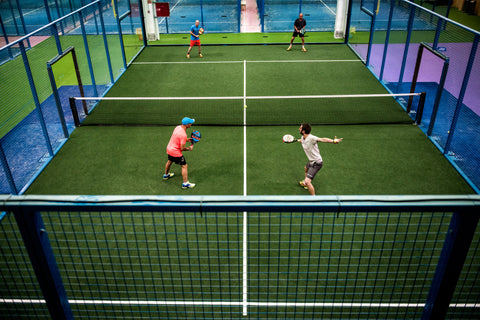
Padel is played two against two on a 20 x 10-metre enclosed court surrounded by glass walls. The scoring system is identical to tennis (15, 30, 40, game): you need six games to win a set and two sets to win the match. The serve is underhand, below the hip and diagonal. The glass walls are part of the game: after a bounce on the ground, the ball may bounce off them before being returned.
|
Key takeaways • Court: 20 m x 10 m, enclosed by glass walls and mesh fences; net 88 cm high at the centre. • Scoring: 15, 30, 40, game; 6 games for a set, 2 winning sets, 7-point tie-break at 6-6. • Serve: underhand, below the hip, after a bounce, diagonally, with 2 attempts. • Glass walls: playable after the first bounce on the ground; returning directly into the mesh is prohibited. • Padel is played exclusively in doubles, and the wrist strap is mandatory for safety. |
Table of contents
• Dimensions and key elements of the padel court
• How scoring works and special cases
• Racket, ball, clothing: equipment that meets regulations
• Specific rules for putting the ball into play on serve
• How to position yourself properly when serving and returning
• Rules during play: tennis with glass walls!
• Why doubles is the norm in padel
• Respect, attitude and esprit of teamwork on court
• Frequently asked questions
Do you have your first padel match coming up and do not know the rules? Do not worry, this article is here for you. Indeed, with its particular features such as glass walls and the fact that it is only played in doubles, the principles of padel are quite specific: you need to master them in order to progress with confidence.
Similar to tennis but with rules borrowed from squash, let us discover the favourite sport of the Spanish.
Dimensions and key elements of the padel court
First of all, it is important to know which court you are playing on. Smaller than a tennis court, of course, the padel court has only 2 lines marking the service boxes, located 6.95 m from the net. No tramlines or baselines: the glass walls do the job perfectly.
With a surface measuring 20 metres long by 10 metres wide, it is much smaller than a tennis court, although it is played two against two. The glass walls and mesh fences must also be at regulation heights. The upper glass wall must therefore be 3 metres high, with 1 metre of mesh above it. For the side glass walls, 3 metres is the regulation height without added mesh.
On the sides, glass walls and mesh fences share the lateral length of the court. 4 m for the glass walls and 6 m for the mesh fences, which also include the space for entering and leaving the court. In height, at least 6 metres are needed to have room to play lobs and other high balls. The net must logically span the width of the court (10 m), and its regulation height is between 88 and 92 centimetres. All these regulations are numerous and demanding for clubs wishing to add padel courts, but they are important for players, especially high-level players, so they do not lose their habits.

How scoring works and special cases
The first similarity between padel and tennis is that points, games and sets are counted in the same way in both sports. Games are scored 15, 30, 40; however, advantage rules apply depending on the country or professional circuit. On the World Padel Tour, the “punto de oro”, or golden point for non-Spanish speakers, is used, meaning a deciding point at 40-40. On other circuits, the advantage rule is adopted.
6 games are needed to win a set, and 2 sets are needed to win a match, quite simply. If both pairs reach 6 games all, there is a tie-break to 7 points with a 2-point margin. In some tournaments, a 10-point super tie-break may replace a possible third set to shorten match duration.
In addition, as in tennis, players change ends after every odd-numbered game. At the end of the set, if the total number of games is even, players rest and resume their positions during one game, then change ends in the following game. During tie-breaks (or a 10-point super tie-break), players change ends and rest every 6 points.
Good to know: depending on the tournament, several official formats exist (with or without a deciding point, with a super tie-break instead of the third set). If you are planning to start competing, take a look at our advice on padel tournaments so you are not caught off guard on the day.
Racket, ball, clothing: equipment that meets regulations
As for the equipment you need, there are very few constraints. You simply need a padel racket and padel balls. When it comes to the racket, depending on your budget and playing level, a wide selection of products is available. Lightweight, round, heavy, carbon rackets, with one hole or several... Many types of rackets exist, and it is important to choose carefully!
In terms of regulations, a padel racket is solid, unstrung, perforated with holes, and generally weighs between 350 and 390 grams. Above all, one safety rule applies to everyone: wearing a wrist strap is mandatory. This strap attached to the wrist prevents the racket from slipping away during a rally and injuring a player. Never forget it, even in a friendly match.
As for the balls to use, padel balls are exactly the same as tennis balls. The only difference is that padel balls are less pressurised and therefore bounce less. As for clothing, wear fairly lightweight clothes that allow fluid movement. To date, there are no restrictions in the rules as long as you do not play in a three-piece suit or swimwear, for example.
Specific rules for putting the ball into play on serve
To put the ball into play in padel, the same system as in doubles tennis matches is used. One player serves for a full game, then the two teams alternate. The aim is for all 4 players to serve in tour. During play, the serve alternates sides, starting from the right. As in tennis, you must serve diagonally into the designated service box. Note that the lines on the court are only used for serving. Here are some important points you need to know to serve properly:
- In padel, the serve is played below hip level, underhand, with a bounce before hitting. It is forbidden to hit it too high to avoid overly fast serves.
- The serve must not bounce off the mesh after its first bounce either. So forget deceptive cross-court shots… However, bounces off the glass walls are allowed as long as the first bounce takes place in the service box.
- If the ball hits the net before bouncing in the opponent’s service box, it is called a let and the serve is replayed. However, if the serve is a let and is then faulty (outside the box or into the mesh), the point is not replayed; it is considered a fault.
- Finally, as in tennis, a second serve is allowed if the first one is missed.

How to position yourself properly when serving and returning
Padel is a sport played two against two. When serving, the 2 receivers can stand wherever they want on the court, but they are not allowed to return the serve as a volée. Most receivers therefore stand behind the line. In padel, positioning between teammates is very important; they often move forwards and backwards at the same time to form a straight line and leave as little angle as possible to the opponent.
As receivers must return from "the back of the court", servers can take advantage of this to move into the preferred position, the net. The player serving must stand behind the line, but their teammate can stand wherever they wish. They therefore often stand at the net, waiting for their partner to join them after serving.
During play, players often occupy two positions: at the back of the court and at the net. The intermediate area, around the service line, is an area to avoid because it is vulnerable to angles and different ball lengths. The position at the net is the best one to take because it allows you to finish points more easily with a smash or a volée. To counter volleyers, the lob is the best option to force them back to the rear of the court and make them lose this advantage. After a lob, moving up to the net is often done to take the preferred position and gain the upper hand over the opponent.
Rules during play: tennis with glass walls!
What are the most common errors?
In padel as in tennis, the most common errors are those in length and height. Net errors or balls that hit the glass wall before bouncing are common mistakes among beginners (and some experienced players who will not admit it). As playing hours build up, with adaptation to the racket and court dimensions, these errors become less and less frequent, at least when the opponent is not putting you under pressure.
Of course, only 1 bounce is allowed before returning a ball sent by the opponent; otherwise, the ball is said to have bounced twice and the point is lost. Finally, a specific feature of padel is that you are not allowed to return a ball by hitting the front mesh first. Only the glass walls may be used to help return the ball.
Glass walls, essential elements in padel!
Glass walls are THE defining feature of padel, making it a unique sport. It is possible to play several shots, sometimes spectacular ones, using the glass walls to get out of difficult situations.
Indeed, in certain situations, often urgent ones, it is possible to bounce the ball off the glass wall to return it to the other side of the net. Whether using the back glass walls or the side glass walls (which is more difficult), this often produces spectacular points.
Otherwise, more simply, the “glass-wall return” is a shot to master as quickly as possible because it is so useful. After bouncing off the glass wall, the ball slows down and can be played more easily. The difficulty with this shot is positioning and anticipating the bounce. You need to be close enough to the glass wall not to be caught by surprise, and you must also make a rotational movement with the hips to return the ball into the opponent’s court. This movement requires some practice, and beginners struggle to use it at first because it is not very intuitive, especially for former tennis players. But with repetition, the shot becomes more natural and makes certain rallies much easier.

Hit smashs (almost) like the pros.
At a higher level, par 3s and par 4s can be played. This involves hitting a powerful smash so that the ball leaves the court. A par 3 means that the ball exits from the side of the court, where the glass wall reaches 3 m. A par 4 means that the ball exits where the glass walls are highest, over the back glass wall. To hit your best par 3s and get all the keys to playing these shots, read this article on par 3 smash shots.
Why doubles is the norm in padel
Another feature of padel is playing 2 against 2. This adds a tactical dimension as well as an esprit of teamwork that is uncommon in racket sports. Communication is therefore essential in several situations:
- Call out how many players are at the net during lobs. Your partner can then adjust their shot (lob, drop shot, passing shot) while keeping their eyes fixed on the ball.
- Agree on who takes the balls in the middle of the court. As you play more matches with a teammate, these details will no longer be a problem .
- To avoid accidents. A padel racket is quite hard, especially the frame, which is sometimes made of carbon. A hit can happen very quickly if communication between players is poor and can cause serious damage.
Positioning on the court is also important. The well-known “right-side players” and “left-side player” often heard about in clubs are defined by their position on the court. Left-side players are most often the more powerful ones or those with better smash quality, because lobs sent down the middle land on the left-side player’s forehand and are therefore easier to accelerate. Padel rackets preferred by these players are often powerful rackets, allowing them to be even more aggressive.
Right-side players, on the other hand, hit slightly fewer balls and should play with less risk, relying more on lobs and returns than power. Their diagonal is on their forehand, normally the most intuitive and easiest shot in padel, so it is easier for them to control the ball. All these "principles of play" apply if both players are right-handed. If one player is left-handed, it is best for them to play on the right so they can use their forehand for a smash and thus unsettle the opponents, who do not know how to defend. However, communication between players is essential, which makes padel almost a team sport.
Respect, attitude and esprit on court
In padel, the most essential rules are fair-play and friendliness. On and off the court, a good atmosphere prevails among players. It is common for bars or restaurants to be linked to padel clubs, as in Spain, and for players to have a drink or a bite to eat together before or after a match. The main aim of padel matches is to have fun and enjoy a good time, so do not hesitate to invite your friends!

Frequently asked questions
How are points scored in padel?
Exactly as in tennis: 15, 30, 40, then game. At 40-40, either advantage is played or a deciding point (the « punto de oro »), depending on the circuit. You need six games with a two-game margin to win a set, and two winning sets to win the match. At 6-6, a 7-point tie-break decides between the two teams.
How do you serve in padel?
The serve is underhand: first let the ball bounce on the ground, then hit it below hip level, behind the line. The ball must then land diagonally in the opponent’s service box. You are allowed two attempts, and bounces off the glass wall are permitted as long as the first bounce is in the correct box.
Can you play off the glass walls in padel?
Yes, and that is the magic of padel. After the ball bounces on the ground on your side of the court, you can let it hit a glass wall and then return it. However, you are not allowed to return it by hitting it directly into the mesh: only the glass walls help put the ball back into play.
Is padel played as singles?
In the vast majority of cases, no: padel is played in doubles, two against two. Singles courts, which are narrower, do exist but remain rare. It is precisely doubles play that gives padel its tactical richness, with constant communication between partners.
Is the wrist strap mandatory in padel?
Yes. The wrist strap, this strap attached to the wrist, is a safety rule: it prevents the racket from slipping away during a rally and injuring someone. Padel rackets, which are solid and unstrung, weigh between 350 and 390 g, hence the importance of holding them properly throughout the match.
Summary
The rules of padel are easy to grasp: an enclosed court, a scoring system borrowed from tennis, an underhand serve and glass walls that extend rallies. After just a few matches, these principles become second nature. The rest is developed on court… with a racket suited to your level.