FIND YOUR RACKET
 COMPARE MODELS
Positioning yourself well in padel: the ultimate guide
Success in padel relies not only on technique and strategy but also on the essential art of positioning. Good positioning enables you to respond effectively to opponents' balls, maximise your shots, and strengthen your defence and attack.
This article explores the fundamentals of positioning in padel, focusing on the strategic home position, choosing which side of the court to play on, and tips to improve your game.
Positioning overview
The importance of being in the right place
Positioning in padel directly influences your ability to play and anticipate opponents' shots. Good positioning allows you to cover the court effectively, optimise rebounds off the glass, and prepare strategic responses to opponents' attacks.
The basic principles
- Back of the court vs in front of the net: The decision to position yourself at the back of the court or near the net depends on the phase of play. In defence, favour a deep position to cover wide angles. In attack, move closer to the net to apply pressure.
- Position relative to the ball: Your positioning and that of your padel racket must always be adjusted according to the ball's position on the court. This helps you anticipate opponents' shots and choose the most strategic response.
How to choose your side of the court
The choice of playing on the right or left side of the court depends on your skills, your preferred shot (forehand or backhand), and sometimes your compatibility with your partner.
Assess your own strengths and those of your partner to decide on the best positioning. The player stronger at smashes and attacking is often positioned on the left. The presence of a left-handed player in the team can offer a tactical advantage by changing the traditional positioning pattern.
Focus on the Home position
What is the "Home" position?
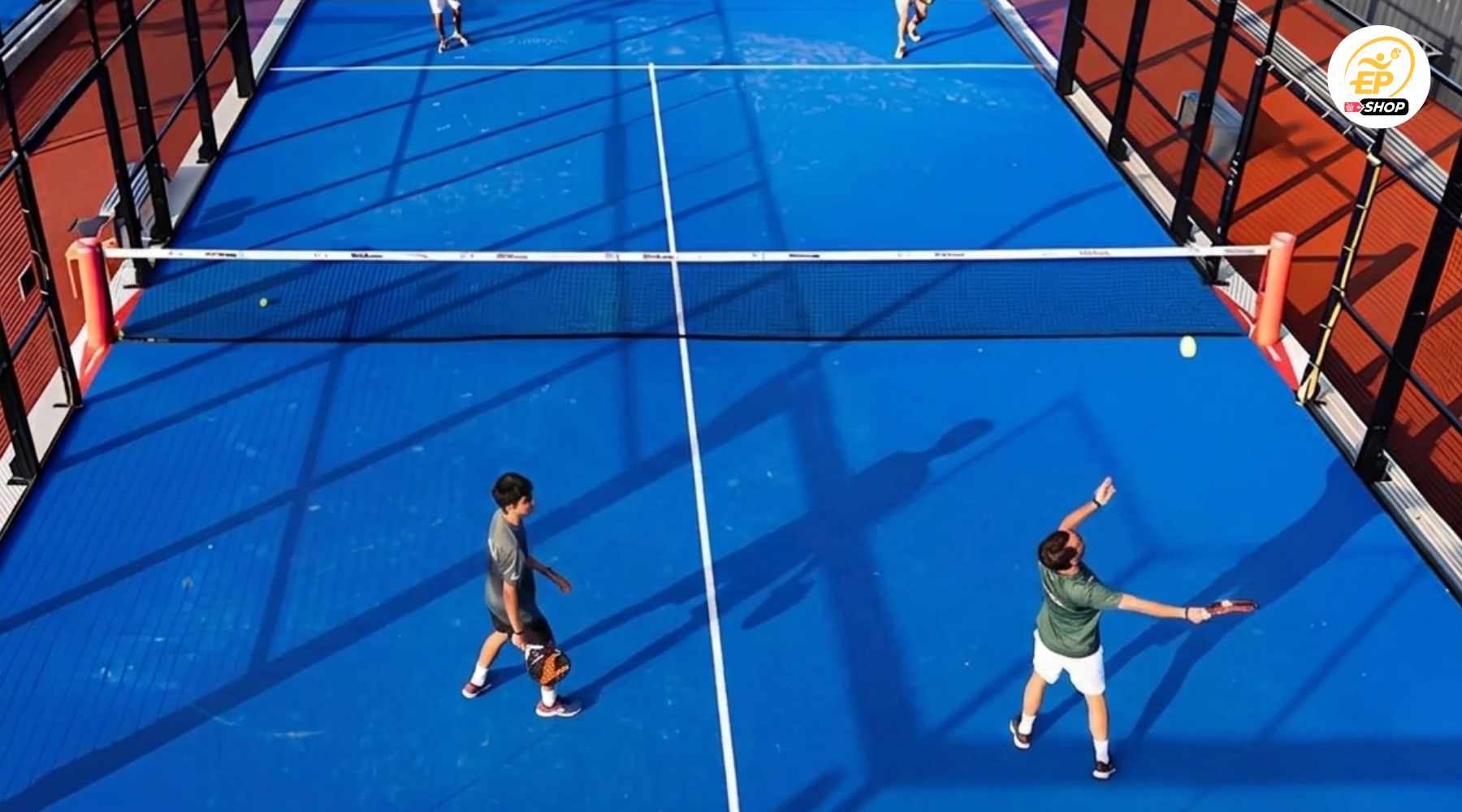
You may have already heard of it: the home position is a crucial tactical concept in padel and refers to an ideal imaginary area for responding to opponents' shots in defence. Located at the intersection of the first side glass panel and the glass joint behind you, it offers a strategic advantage for countering attacks.

This is the basic position at the back of the court. For more details on this positioning, you can consult the FFT tutorial:
How to position yourself well? - Padel Tutorial #4 | FFT
Why use the Home position
This slightly off-centre position is ideal for allowing you to play difficult balls that rebound off the side glass or the back glass diagonally, without preventing you from playing the easier balls in the centre.
If your opponent tries to move you out of this comfort zone by playing a ball towards the centre, remember to reposition yourself immediately. This must become a reflex and will allow you to greatly improve your game, by playing all your shots from this same reference point. This is one of the keys to progressing in padel.
Naturally, if the opponent is preparing to hit a powerful smash, it becomes necessary to leave the home position, rushing quickly forwards, which will require more than just one or two steps. Understanding and adapting to the opponent's game is crucial. The "home" position requires flexibility to adapt to different types of smashes, from flat shots to attempts to bounce the ball off the back glass or the fence. Reactivity and anticipation are key to making the most of this strategic position.
Net play and coordination with your partner
Positioning yourself effectively at the net is crucial to dominating the game. Learn to anticipate opponents' balls, place your volleys precisely, and use the net to put your opponents under pressure. Managing positioning and movement in attack in padel requires excellent coordination and communication between partners.
The server must quickly position themselves at the net after serving to set up an effective attack. The server's partner, often already at the net, must move across to cover the space and prepare a coordinated response.
Indeed, in padel, the 2 players on the same team must be at the net in attack or at the back of the court in defence at the same time (in the home position). It is rare to find one player at the net and the other in defence.
At the net, the distance between the 2 players is slightly reduced compared with the defensive position: they must be close enough to prevent a ball from passing between them.
Good to know: if you would like to read more tips to improve your net game, beyond positioning and movement, you can consult our detailed article on mastering your net game in padel.
Also note that your racket is crucial for this phase of play: impact of racket weight on your game.
In conclusion, positioning yourself well in padel is an essential skill that requires understanding, practice and, above all, continuous adjustment. The benefits of padel partly come from the fact that you are constantly on the move! By mastering the principles of positioning, strategically using the home position, and wisely choosing your side of the court, you can significantly improve your game and tactics in padel.
Remember, padel is a team sport; communication and coordination with your partner are therefore just as important as your individual positioning!