FIND YOUR RACKET
 COMPARE MODELS
Wheelchair padel: a passion accessible to everyone
It is well known that sport breaks mental boundaries. Padel, with its growing rise and adaptability to physical and mental diversity, has therefore opened up to wheelchair play, offering wider accessibility.
Adapted competitions are emerging in this sport, supported by dedicated organisations. Regulatory adjustments and specific equipment are there to foster better inclusion. Now, the French Tennis Federation (FFT) organises wheelchair padel competitions, bringing official recognition to this adapted sport and strengthening its growth on the national sporting scene.
Introduction to wheelchair padel
Wheelchair padel rules
Playing wheelchair padel requires adjustments to the rules of padel traditionally. Here are the key changes:
- Three-bounce rule: Two bounces are permitted before impact, any third bounce ends the point.
- Contact with the wheelchair: The player must remain in contact with the wheelchair at all times, without placing a foot on the ground to push off or brake.
- Player falling: If the player falls, play continues.
- Chair integration: The wheelchair is part of the player; if the ball touches it, the point is over.
- Wheelchair repairs: Repairs may not exceed 20 minutes, and adjustments are limited to 10 minutes.
For the serve:
- The serve may be hit below shoulder height.
- The front wheels must be behind the service line.
- If having difficulty serving, the racket can be used to help with the bounce.
As for doors, a minimum of two 1.05m-wide doors must be available to allow unobstructed entry for the wheelchair.
The padel wheelchair: key equipment
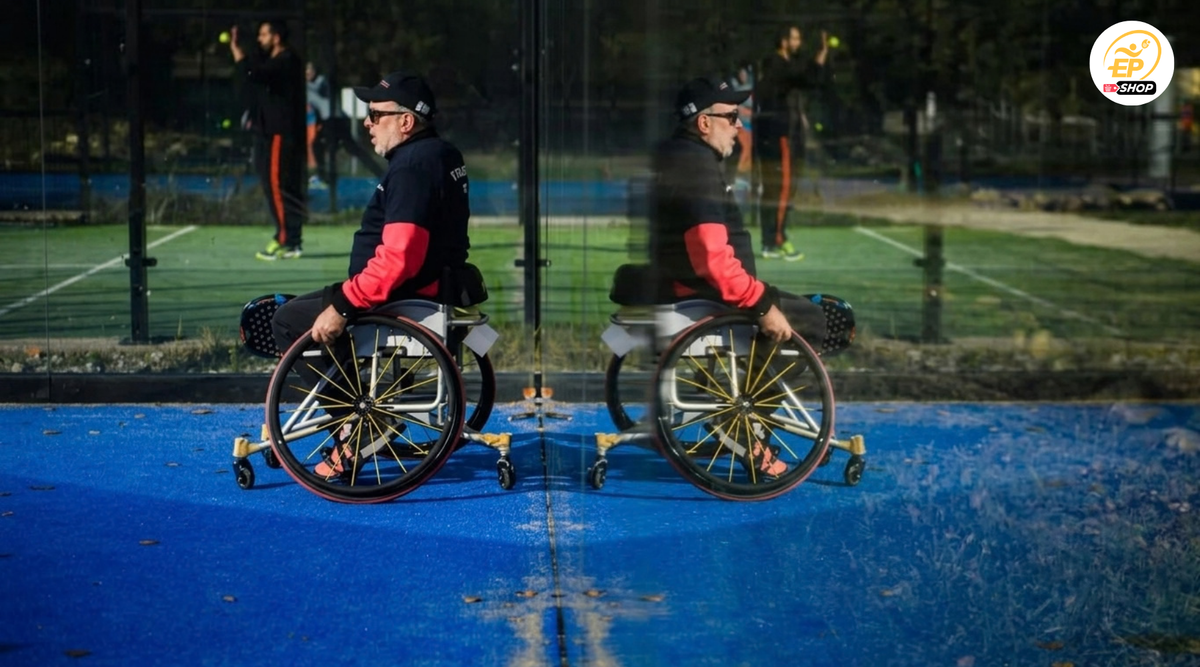
Wheelchairs used for padel differ from ordinary wheelchairs used in everyday life. They are designed to be lighter, sturdier, and have no brakes. Their wheels are attached to the chair at an angle, and the more pronounced the angle, the higher the potential speed.
These wheelchairs have smaller wheels to gain speed, and the camber also provides better stability. Larger wheels allow players to cover greater distance with less effort, but setting the wheelchair in motion is slower. They are also equipped with additional mini wheels for better balance.
Each chair is adapted to the player, taking into account their weight, height, and the type of injury they have sustained. For a lower-body injury, the chair offers moderate support because the player can use their abdominals and trunk. In contrast, for spinal injuries in the upper regions, more support is required. The chair often has straps that allow the player to secure themselves.
The cost of these wheelchairs is generally between €2,500 and €3,000, without financial support.
There are specific wheelchairs for each sport, however, tennis wheelchairs are also suitable for playing padel.
A few tactical elements specific to wheelchair padel
The tactical specificities of wheelchair padel require a precise understanding of positioning on the padel court and strategies adapted to wheelchairs.
Indeed, the wheelchairs used cannot move sideways like an able-bodied player. This means that at the volée, any wheelchair player is very vulnerable, as they can easily be passed with lateral shots if they cannot reach the padel ball with their racket: they lack that lateral mobility.
Player positioning is mainly divided into three zones: defence behind the service line, the risk zone above the service line for transition, and attack, but without getting too close to the net to avoid being easily bypassed.
As in classic padel, tactics focus on the players' own characteristics and their weaknesses. Against fast players, you must try to avoid fast, lively balls and encourage them to play from the back of the court where their mobility is less advantageous. For slower players, moving the opponent around becomes crucial, leaving them with spaces they will struggle to recover.
Developing tactics before each match, taking into account partners and opponents, their technical skills, and their wheelchair mobility, proves essential. This understanding helps to better anticipate and select the right shots to maintain court coverage without exposing your partner.
In a wheelchair, recovering after each rally requires more energy. Therefore, precise shot selection is crucial to maintain court position and teamwork. A good connection with your partner and consistent execution of the chosen tactics are essential elements.
Who can take part in official competitions?
Eligibility for wheelchair padel competitions
Wheelchair padel competitions are open to people with various disabilities such as neurological diseases, spinal cord injuries, amputations (from the total loss of the big toe), chronic consequences following hip or knee replacement (provided pain is not the only consequence), and limb length differences greater than 6 cm.
Player classification according to disability:
Players are classified on a scale from 1.0 to 4.0 (not to be confused with the padel ranking). The higher the number, the less the player is limited in their movement by their disability. A pair of players can never exceed a total of 5 points:
- Player 1.0: No frontal, lateral, or vertical trunk control, requiring support against the wheelchair.
- Player 2.0: Partial trunk control with vertical and frontal limitations, but no lower trunk or leg control.
- Player 3.0: Trunk control except in the lateral plane.
- Player 4.0: Trunk control with limitation in the lateral plane.
The benefits of wheelchair padel
Playing wheelchair padel brings a wealth of physical, mental, and emotional benefits.
For wheelchair users, this sport intensifies the workout of the upper body, strengthening muscles and improving joint mobility. Players develop skills such as balance, reflexes, and coordination, which are essential to master this demanding game.
Beyond the physical benefits, wheelchair padel offers a great opportunity for self-improvement. The constant desire to perfect every movement, combined with increased motivation to overcome the obstacles inherent in disability, fosters personal and emotional growth.