FIND YOUR RACKET
 COMPARE MODELS
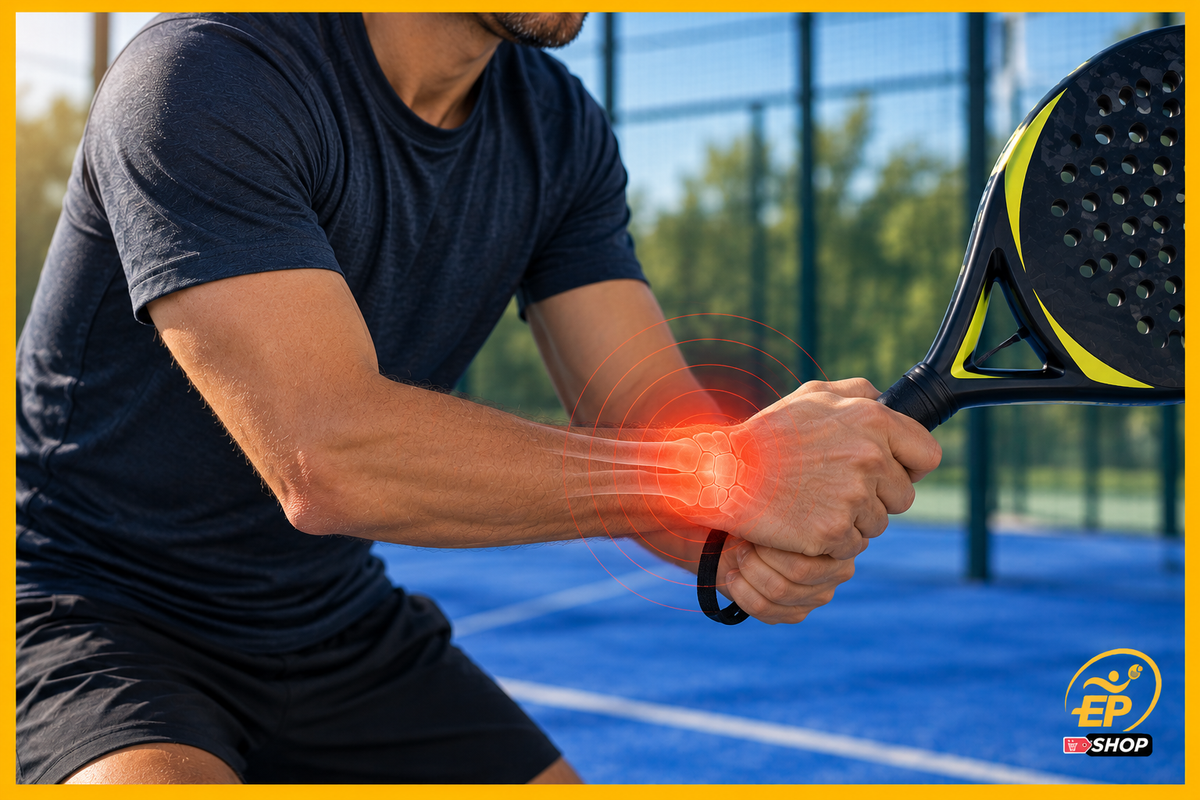
Wrist pain in padel is almost always caused by repeated strain on the tendons, brought on by strokes that rely too much on the wrist, balls hit off-centre on the racket or poorly adjusted equipment. It develops gradually, without a specific impact, and rarely goes away on its own if nothing changes. Here’s how to identify the cause, spot the warning signs that call for advice from a healthcare professional, and adjust what you can.
Key takeaways
|
What causes wrist pain in padel?
Technique-related causes: when the wrist compensates
Padel involves short strokes, often played under pressure, and it’s easy to rely on the wrist. A player who is late to the ball swings with the hand alone: the power no longer comes from the hips or shoulder, but from the most vulnerable joint in the chain. The result is repeated small stresses on the tendons.
Two shots pose the greatest risk: a smash hit with force while the wrist bends forwards, and a shot off the wall played too close to the body. At impact, your wrist should stay firm and aligned with your forearm, as explained in our article on padel technique for beginners. Our padel tutorial to help you improve takes you through these shots step by step, and the wrong racket grip tops the list of beginner mistakes.
Equipment-related causes: what your racket is putting you through
A head-heavy racket tires your forearm with every shot. If it’s too stiff, it sends vibrations through your wrist. Add a handle that’s too thin and you have to grip tightly all the time to compensate, tensing your whole arm. Balls matter too: when worn or damp, they become heavy and every impact takes more effort.
The overlooked issue is often the racket grip: if your hand is poorly positioned, your wrist has to readjust at the last moment on every ball. It’s the first thing to check before blaming the racket.
Warning signs you shouldn’t ignore
Not all pain is the same: discomfort the day after a long session is very different from pain that wakes you at night.
|
Sign observed |
What it means |
|---|---|
|
Mild discomfort that disappears within 24 to 48 hours |
Temporary overload: reduce how much you play |
|
Pain lasting more than 72 hours |
Advice from a healthcare professional recommended |
|
Swelling, clicking or warmth around the wrist |
Don’t delay seeking medical advice |
|
Loss of strength when holding a racket or another object |
Don’t delay seeking medical advice |
|
Pain at night or at rest |
Don’t delay seeking medical advice |
6 steps to ease wrist pain
1. Take a few days off playing. It’s the most effective and most overlooked measure. Returning at 50% of your usual playing volume helps prevent a relapse.
2. Have your technique checked. A session with a coach can identify a wrist that bends at impact, where months of trying to correct it yourself may fail.
3. Build up your grip. One or two extra overgrips mean you don’t have to grip as tightly, helping your forearm relax. Our overgrips and racket accessories cover every thickness.
4. Change your balls more often. Fresh balls take less effort to hit than worn-out ones, especially outdoors.
5. Warm up your wrist. Circles, flexions and extensions for one minute before the first rally.
6. Seek advice if the pain returns. A physiotherapist or sports doctor can make a diagnosis that no article can.
Prevent pain before it takes hold
Strengthen your wrist and forearm in just a few minutes
The aim isn’t to build muscle, but to improve tendon resilience. Three exercises, twice a week, are enough: wrist curls and extensions with a light dumbbell, eccentric work (lift quickly, then lower over five seconds), and squeezing a padel ball in séries. A conditioned forearm absorbs vibrations that the wrist would otherwise bear alone.
Choosing a racket and grip that protect your wrist
If you’re prone to pain, look for a round, relatively light racket made from flexible carbon or fibreglass, with a low balance. It’s more forgiving on off-centre balls and transmits fewer vibrations. Our range of rackets for beginners and players prone to discomfort brings together options with these characteristics, while our annotated selection covers each model in detail. Consider a frame protector too: it helps preserve the racket and its original stiffness.
Frequently asked questions
Why does my wrist hurt after playing padel?
In the vast majority of cases, it’s tendon overload caused by strokes that rely too much on the wrist, off-centre hits and unsuitable equipment. The pain develops gradually, without an identifiable impact. If it lasts more than three days, have it assessed by a healthcare professional.
Should you stop playing when your wrist hurts?
Yes, at least temporarily. Playing through the pain is the surest way to turn a few days of discomfort into an injury that lasts months. Play less, give it a few days, then see how it feels when you return. If the pain comes back quickly, stop and seek medical advice.
Will a lighter racket solve the problem?
It helps, but it’s no miracle cure. Balance and stiffness matter as much as weight: a very head-heavy lightweight racket is more tiring than a slightly heavier one with a low balance. A round shape and a flexible frame remain the best choices for protection.
Does a thicker overgrip really protect your wrist?
A handle that’s too thin makes you grip harder to stabilise the racket, tensing your forearm and wrist. Adding one or two overgrips lets you hold it firmly without straining. The adjustment is reversible and costs just a few euros: it’s the first thing to try.
Summary
Wrist pain in padel comes down to three factors: technique, equipment and physical preparation. Keep your wrist stable at impact, adjust the thickness of your grip and choose a forgiving racket, strengthen your forearm, and don’t play through pain. Our article on padel injuries explores the subject further, and our advisers can help you find a racket in our beginner range that protects your arm before you focus on performance.