FIND YOUR RACKET
 COMPARE MODELS
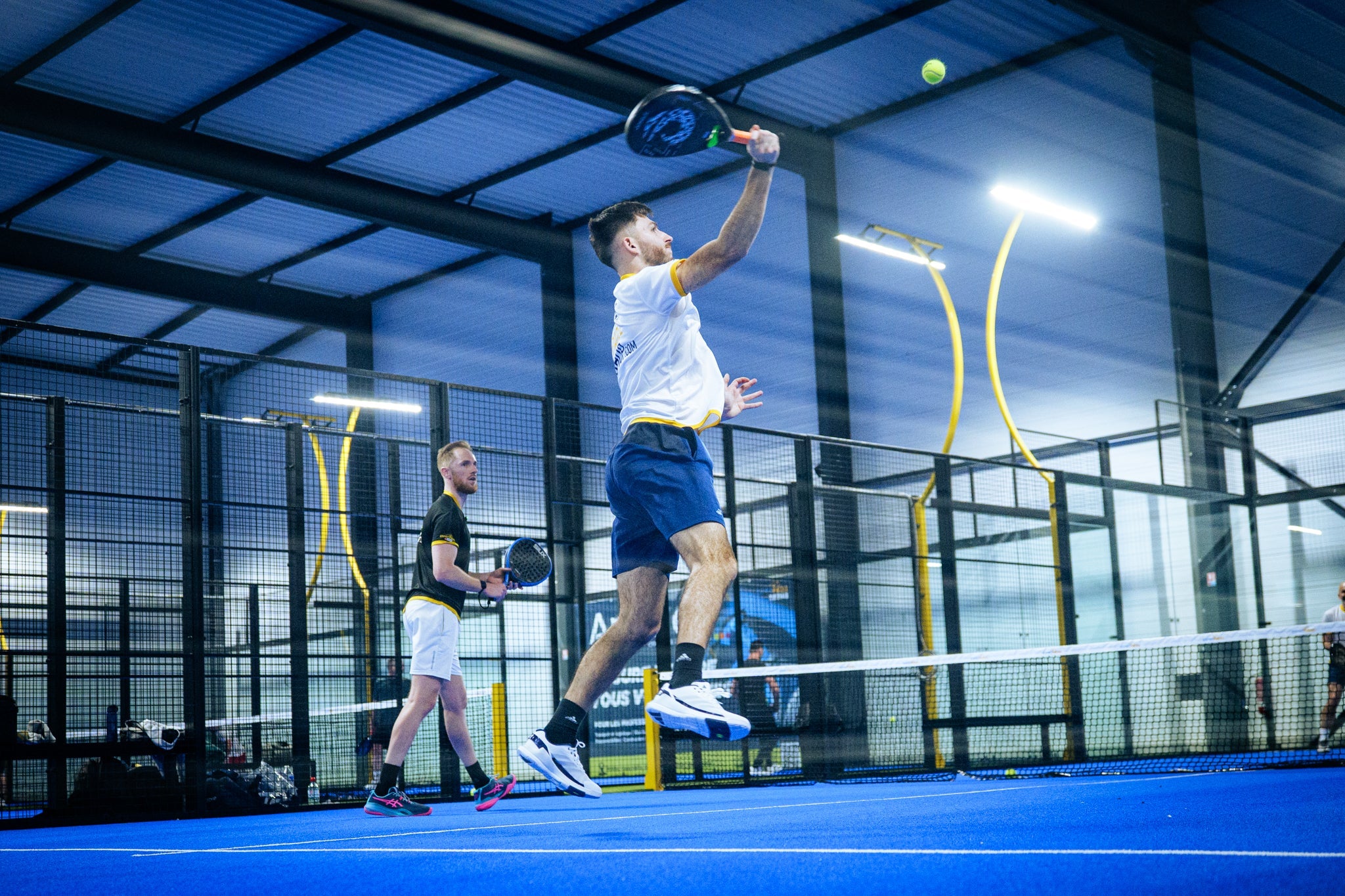
The par 3 in padel is a smash that sends the ball out of the court over the 3-metre-high side fence, after bouncing off the opponent's back glass wall. Hit hard and at the right angle, the ball becomes virtually impossible to retrieve: it is one of the most effective and spectacular winning shots in padel. Successfully hitting a par 3 requires timing and technique above all, not just power. Here is when to attempt it, how to execute it and which racket to use.
|
Key takeaways • The par 3 is a smash that sends the ball out over the side of the court (3 m fence). • It should be attempted on a high, fairly short ball when you are well positioned. • Topspin (brushed spin) is key to making the ball kick high off the glass wall. • Not to be confused with the par 4 (exit over the back) or the bandeja (control shot). • A diamond shape racket facilitates execution thanks to its head-heavy balance. |
Table of contents
• What is a par 3 in padel?
• How to hit a par 3: the right timing and the right technique
• Par 3, par 4 and bandeja: do not confuse them
• Which racket should you choose to smash a par 3?
• Frequently asked questions
• Summary
What is a par 3 in padel?
The par 3, sometimes written "por 3" or "x3", takes its name from the height of the side fence: 3 metres. In fact, our padel glossary lists all these terms. The objective is to smash the ball so that it bounces in the opponents' court, hits the back glass wall, and then exits the court by flying over this side fence. It is a formidable finishing shot.
Be aware, however: the point is not always over. Depending on the court setup, an opponent can run out through the door to retrieve the ball before its second bounce—the famous out-of-court recovery. The par 3 is an attacking shot just like the classic smash: to put this shot into context across your overall offensive game, our dedicated article on the smash details all its variations.
How to hit a par 3: the right timing and the right technique
The 3 conditions for attempting a par 3
A par 3 should not be attempted on just any ball. Ideally, three conditions should be met at the same time.
1. A high and fairly short ball: an opponent's lob that lands in your attacking zone, between the net and the service line, gives you time to get properly positioned.
2. Good balance: feet set and body already turned. Attempting the shot while moving backwards or off-balance is the surest way to miss it.
3. Opponents at the back of the court: they give you the angle and space needed to aim for the exit zone over the side.
The technique: positioning, point of impact and spin
Position yourself slightly behind the ball to hit it out in front of you, at the highest possible point. Transfer your body weight from the back leg to the front: this provides power and depth without forcing with the arm. The secret to the par 3 is topspin: by brushing the ball, you give it spin that makes it kick upwards after bouncing off the glass wall. If you are moving back to hit it, stop your momentum at the moment of impact to channel maximum energy into the ball.
Par 3, par 4 and bandeja: do not confuse them
These three shots are all played overhead, but their intentions are completely different. The par 3 aims to send the ball out over the side. The par 4 sends the ball out over the back glass wall (around 4 metres): it is a shot of pure power, hit flat, and even more difficult. The bandeja, on the other hand, is not a finishing shot: it is a control, sliced smash used to safely maintain position at the net.
Reading the ball well means knowing what to choose: on a perfect ball, attempt the par 3; on an average ball, play it safe with a bandeja. To explore the difference between control and attacking shots further, read our article on the bandeja and the víbora. And to see how each shot fits into the bigger picture, our padel techniques review all the essential shots.
|
Shot |
Exit / objective |
When to use it |
|
Par 3 |
Exits over the side (3 m fence) |
High and short ball, good position |
|
Par 4 |
Exits over the back (~4 m), flat |
Perfect ball, plenty of power |
|
Bandeja |
Stays in play, control shot |
Average lob, hold the net |
Which racket should you choose to smash a par 3?
The par 3 rewards technique, but the right equipment makes execution significantly easier. Diamond shape rackets, which have their weight distributed towards the head, provide more inertia on overhead shots: ideal for explosive smashes. A certain rigidity also helps to transmit power. On the flip side, these palas are more demanding and less forgiving: they are mainly aimed at players who are already technically proficient.
If you are unsure which model to choose, our comparison of powerful padel rackets will help guide you, and you can find all the palas in our catalogue of padel rackets.
Frequently asked questions
What is the difference between a par 3 and a bandeja?
The bandeja is a control smash, hit with slice, that keeps the ball in play and allows you to hold the net. The par 3, however, is a finishing shot: it aims to send the ball out over the side of the court to win the point. In short, the bandeja secures the point, while the par 3 finishes it.
What is the difference between a par 3 and a par 4?
Both send the ball out of the court, but not in the same place. The par 3 sends it out over the side, over the 3-metre side fence. The par 4 sends it out over the back, over the back glass wall (around 4 metres). The par 4 is hit flat and demands even more power: it is therefore rarer.
Why is my ball not going out on a par 3?
Most often, it is because the strike is too low or the angle is poorly chosen. The higher you hit and brush the ball (topspin), the more it kicks after bouncing off the glass wall. Check your positioning too: if you are too far away or off-balance, you lose power and accuracy. Work on the topspin first, and the exit will follow.
Do you need to be an advanced player to hit a par 3?
It is not reserved exclusively for pros, but solid smash technique helps a lot. The key remains timing, not brute force: you can therefore start working on it early, on high balls and with a controlled movement. In matches, only attempt it when you are virtually certain to send the ball out of the court, otherwise play it safe with a bandeja.
Summary
You now know what a par 3 is: a smash that sends the ball out over the side, to be attempted on a high, well-placed ball by relying on topspin rather than brute force. By integrating it smartly into your game, you will sow doubt in your opponents with every lob. To give yourself the best chance, choose a racket built for attacking: discover our rackets for advanced players, engineered for power and spin, and practise this shot regularly.