FIND YOUR RACKET
 COMPARE MODELS

To help you choose the right padel racket, we’ll first explain what one is and the important characteristics to consider.
What a padel
A padel racket is made up of four distinct components:
- The racket frame
- The racket’s foam core
- The hitting area
- The racket’s outer layer
All rackets must meet regulations covering a number of criteria. These rules come from the International Padel Federation and are as follows:
- Length: 455 mm
- Width: 260 mm
- Thickness: 38 mm
- Hitting area: 300 mm long and 260 millimetres wide
- Hitting area : holes with a diameter of 9 to 13 mm; their number is not limited
- A safety strap must be fitted to the end of the handle and must be no longer than 350 mm.
Beyond these regulatory requirements, it is important to understand the 5 technical characteristics that define a padel racket. Their combination makes each racket unique and determines whether or not it suits you and your game!
The main features of a padel racket
The racket’s shape
Rackets come in three different shapes, each suited to a style of play.
- Round shape : this shape offers the best control thanks to its generally low balance. Its manoeuvrability makes it easy to feel comfortable quickly with round padel rackets. Below is an example of a round racket.

- Teardrop shape : this shape offers the best balance of control and power. It is therefore recommended for intermediate players (levels 5–8). It is currently the best-selling shape in France thanks to its combination of control and power. Below are several examples of teardrop-shaped rackets.

- Diamond shape : the power this racket shape offers makes it suitable for advanced players with a good technical level. These rackets have a sweet spot that is fairly small, which makes them more technically demanding. Below are some examples of diamond-shaped rackets.

The balance of the racket
Balance is generally linked to the racket shape.
- Round rackets: handle-heavy balance, better manoeuvrability and control, but a loss of power in your shots.
- Teardrop rackets: versatile medium balance, the ideal balance between control and power
- Diamond rackets: head-heavy balance that gives the racket power with a loss of manoeuvrability.
The materials used to make a racket
Manufacturers of padel rackets use the same main materials: fibreglass, carbon fibre and Kevlar. These materials are designed to provide strength, control and power.
- Fibreglass: flexible and durable at an affordable price, but heavy and slow to return to shape after bending. Mainly used on the racket face. For example, the Babolat Reflex is made with fibreglass.

- Carbon fibre: lightweight and fairly stiff, with plenty of explosive power, it is clearly the material of choice for padel rackets right now! The Bullpadel Hack 03 2021, for example, is made with carbon fibre.

- Kevlar: rare due to its high cost, but offers great durability. It can also be used to reinforce specific areas of rackets
Like loose strings, a soft material provides more power but less control, while a hard material gives you greater control over your shots but less power. We’ll devote an article to this topic.
Other "secondary" materials are used to make a racket, such as EVA rubber, foam, titanium and graphite, etc.
The core
In the core of the racket, there are mainly two types of foam: EVA rubber, with all its variations depending on the brand, and FOAM (polyethylene foam).
These two types of foam have opposite characteristics, although brands have introduced developments to offer a wide range of variations for each foam
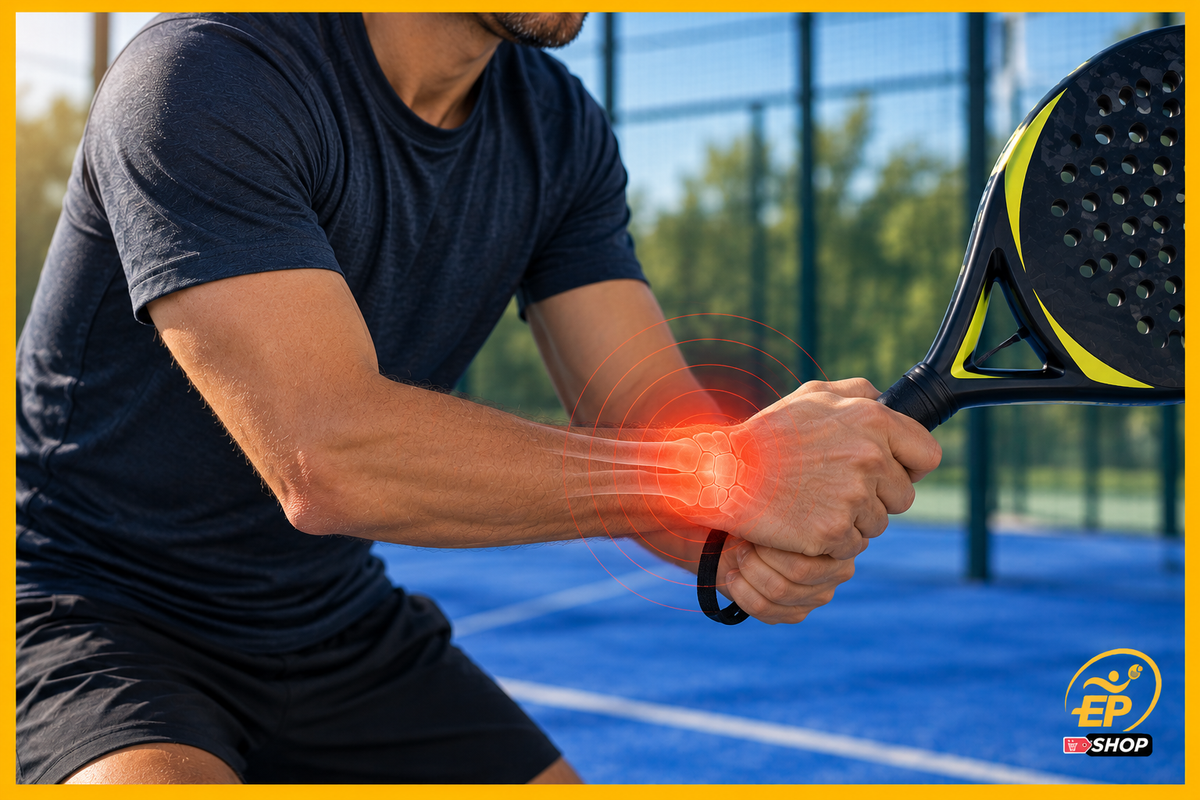
- EVA rubber: hard, less flexible, significant durability. Widely used by various brands, it provides a lot of control thanks to its rigidity. But beware: the rigidity of this foam can lead to injuries, especially if technique is not optimal.
- FOAM foam: soft, with moderate control and moderate power, but very fast ball release. Foam is more fragile, so rackets do not last as long.
The weight
Weight directly influences how you play and is linked to your playing style. The heavier the racket, the more powerful your shots will be. Conversely, the lighter the weight, the faster and more precise you will be, but with a loss of power.
The weight of a padel racket ranges between 300g and 390g.

Sébastien Cornet, Founder of Esprit Padel