FIND YOUR RACKET
 COMPARE MODELS
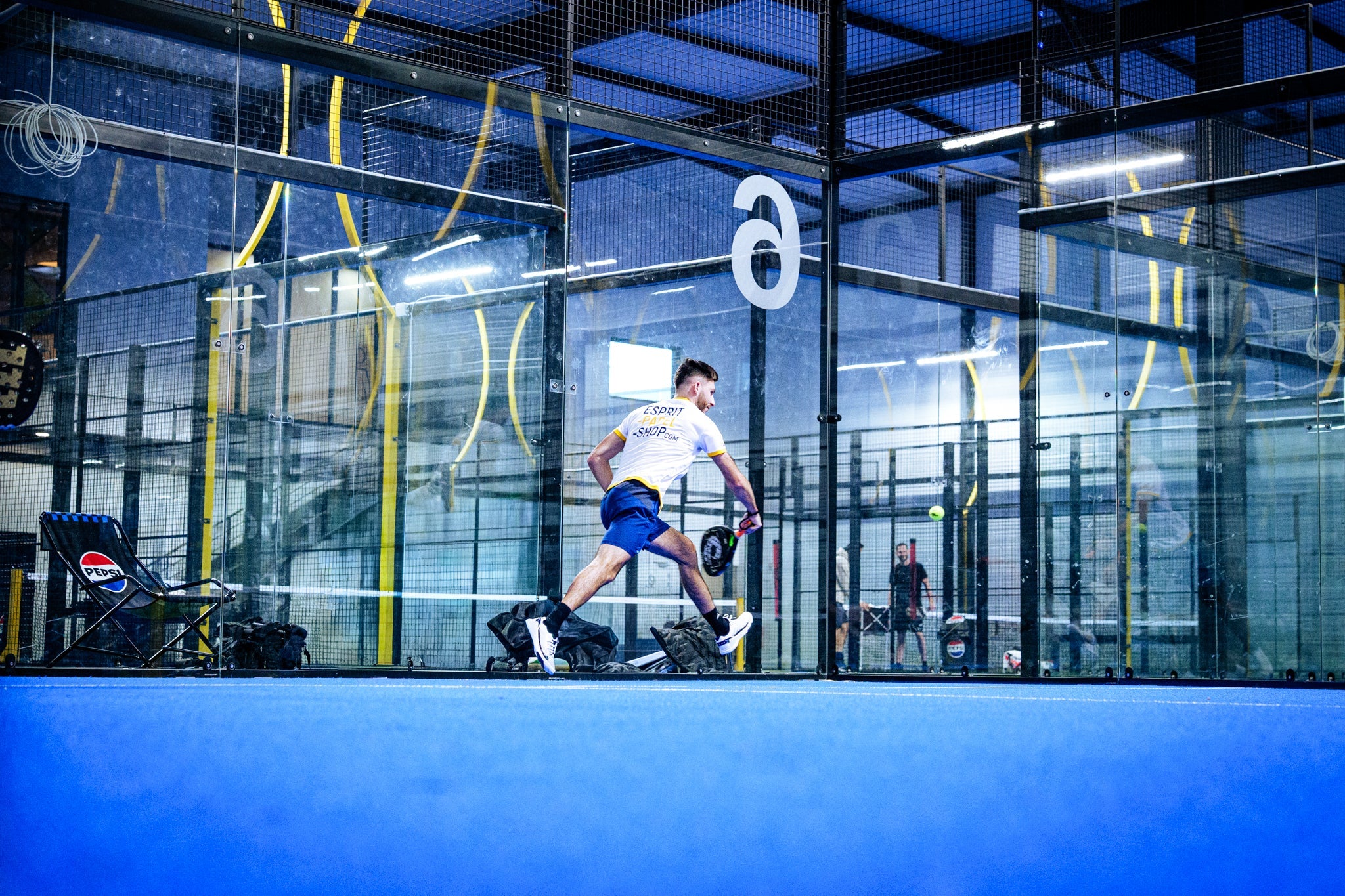
A padel court measures 20 metres long by 10 metres wide, providing a surface area of 200 m². It is a rectangle enclosed by glass walls and mesh, divided into two halves by a net that is 0.88 metres high at the centre. The service lines are located 6.95 metres from the net. These dimensions, defined by the International Padel Federation (FIP), are the same worldwide and across all tournament categories.
|
Key takeaways • Official dimensions: 20 m long x 10 m wide, or 200 m². • Net: 0.88 m high at the centre; service lines 6.95 m from the net. • Walls: 4 m at the back (3 m glass + 1 m mesh), 3 m along the sides. • Clear height: minimum 6 m (FIP), 7 m according to FFT, ideally 8 m for lobs and smashes. • Surface: most often synthetic turf, with or without visible sand. |
Table of contents
• What are the key features of a padel court?
• The dimensions
• The net, walls and clear height
• Types of padel courts
• The differences compared to a tennis court
• Consequences of a non-compliant court
• How do you maintain a padel court?
• Why are padel courts so enjoyable to play on?
• How do you build a padel court at home?
• Frequently asked questions
Whether you are a passionate padel player or simply curious to learn more, today we take a closer look at padel courts.
In this article, we outline the key features of padel courts, from dimensions to available surface types. We will also explore the differences between a padel court and a tennis court, as well as what makes padel courts such an enjoyable place to play.
And for those looking to embark on building their own padel court, we share all our practical tips to help you get started on this exciting project.
What are the key features of a padel court?
The dimensions
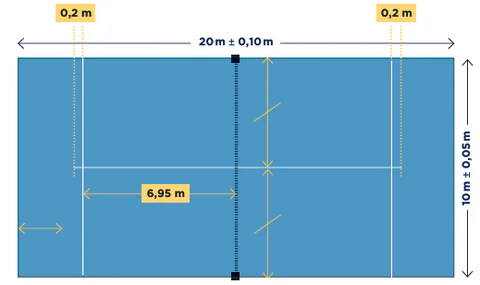
The standard padel court is a rectangle measuring 10 metres wide by 20 metres long. It is divided into two halves by a net. The sides and back of the court are enclosed.
The service lines, parallel to the net, are located at a distance of 6.95 metres from it. A centre line perpendicular to the net and positioned 5 metres from each side of the court marks out the service boxes. This centre line extends 20 centimetres beyond each service line. All lines marked on the court have a width of 5 centimetres.
The clear height must be at least 7 metres, including the metal framework and lighting system.
|
Element |
Dimension |
|
Length |
20 m |
|
Width |
10 m |
|
Total surface area |
200 m² |
|
Net (at centre) |
0.88 m |
|
Service line |
6.95 m from the net |
|
Line width |
5 cm |
|
Back wall |
4 m (3 m glass + 1 m mesh) |
|
Side walls |
3 m |
|
Clear height |
6 m min. (FIP) / 7 m (FFT) |
The net, walls and clear height
Beyond ground dimensions, three key elements define a padel court. The net is 0.88 metres high at the centre and rises slightly towards the posts (to around 0.92 m), creating a natural curve.
The walls, however, are not uniform. At the back of the court, they reach a height of 4 metres: 3 metres of glass topped by 1 metre of mesh. Along the sides, the standard height is 3 metres. These glass panels are an integral part of the game: the ball can rebound off them after its first bounce on the ground.
Finally, the clear height above the court must be sufficient for lobs and smashes. The FIP requires a minimum of 6 metres, the FFT recommends 7 metres (including metal framework and lighting), and court builders often advise 8 metres for optimal playing comfort, especially indoors.
Types of padel courts
Singles or doubles court
Courts designated for official competitions follow the dimensions above. However, there are also singles courts used for one-on-one matches, which have slightly reduced dimensions. They measure 6 metres wide by 18 or 20 metres long. All other features of standard padel courts remain the same.
Court surface: with or without sand
Padel courts are typically covered with a synthetic surface specially designed for the sport. Most of the time, this surface is synthetic turf, either dressed with sand or unfilled. These synthetic turfs are the most common choice: the surface consists of artificial grass with a fine layer of sand spread across it. This layer allows players to slide in a controlled way.
Some facilities also use so-called "sandless" courts. This is a slight misnomer: they are actually courts without visible sand, as the silica does not sit on the surface of the turf. The playing feel is therefore different and may require adjusting your playing style due to the difference in grip compared to classic courts. You can also occasionally find courts made of synthetic resin, porous concrete or even cement (although this material is on the decline).
Whatever the surface, suitable padel shoes remain essential: they provide the grip required to move and slide safely without risking injury on synthetic turf.
Indoor or outdoor
Padel can be played both indoors and outdoors. The choice comes down to personal preference, with each option offering its own pros and cons. The lighting setup is fairly similar in both cases: indoor and outdoor courts are fitted with floodlights delivering maximum illumination and optimal visibility. Outdoor courts require lighting after dark, while indoor courts are generally well lit all day long. If you prefer playing under natural light, an outdoor court during daytime is ideal.
When it comes to the weather, some outdoor courts can be fitted with features to mitigate conditions, such as drainage systems to clear rainwater or windbreaks. However, weather remains a factor to consider outdoors, whereas indoor courts offer complete stability and predictable playing conditions.
Differences compared to a tennis court
As you can see, a padel court actually has very little in common with a tennis court. Here are the main differences:
• The dimensions of a padel court are smaller than those of a tennis court. A tennis court measures 23.77 metres in length, with a width of 8.23 metres in singles and 10.97 metres in doubles.
• A padel court is enclosed on all sides by glass and mesh, unlike a tennis court.
• Tennis courts typically feature hard surfaces (asphalt, concrete or artificial grass). Padel courts, on the other hand, are often covered with purpose-designed synthetic turf, offering a pleasantly cushioned surface.
Of course, padel clothing and the rules of padel also differ from those that apply on a tennis court.
Consequences of a non-compliant court
Risks vary, whether sporting or administrative. Injuries and difficulty finding your bearings on court are the main risk factors when a court fails to meet legal standards. That said, these risks remain relatively minor and depend on your playing level and intensity.
From an administrative perspective, legal consequences and federal sanctions depend on the specific non-compliances with specifications. This can range from a simple fine to a complete overhaul of the infrastructure.
How do you maintain a padel court?
For clubs, court maintenance is essential. The quality of the turf and the amount of sand on it are frequently scrutinised by players, so standards must be impeccable. First of all, keep anything that is not a ball away from the turf (food, drinks, etc.). Impact from rackets must also be avoided.
Sand is also essential: it allows for better sliding across the court, thereby protecting it from potential friction from shoes. It also helps absorb water and prevents turf degradation, which is why it is widely used on outdoor courts. It is advisable to clean and replace the sand on your courts roughly every 4 to 6 months.
Why are padel courts so enjoyable to play on?
In our view, it is the blend of social connection, ease of learning, fast-paced play and surface comfort that makes padel courts so enjoyable for so many players.
Padel courts are smaller than tennis courts, which shortens distances and makes moving around easier. This allows players to focus more on technique and strategy rather than pure physical endurance.
Padel is a fast, dynamic sport featuring numerous rallies. Rebounds off the walls add an extra strategic element, encouraging players to be creative with their shots and court positioning. Finally, the synthetic turf generally covering the court provides a pleasantly cushioned surface, reducing the risk of injury.
How do you build a padel court at home?
From a legal standpoint, if you wish to build an indoor court, you will need to apply for planning permission. If you only want to build an outdoor court, a prior declaration of works with your local authority is sufficient.
Overall, building a padel court from scratch involves the following steps:
• earthworks and soil removal;
• building the porous or solid concrete slab (with slopes for water drainage);
• marking out the playing area;
• installing the metal structure;
• installing the glass walls;
• installing the mesh fencing;
• installing the lighting system;
• laying the synthetic turf, sand and net.
You can also look into setting up your own padel club to share your passion. This video can help you make your choice and take the plunge!
Frequently asked questions
What is the size of a padel court?
An approved padel court measures 20 metres long by 10 metres wide, or 200 m². The central net is 0.88 m high, the back walls reach 4 m (3 m glass + 1 m mesh) and the side walls 3 m. These dimensions are identical regardless of the tournament level, from P100 to P2000.
How much does a padel court cost?
The cost of a padel court usually ranges between roughly €15,000 and €35,000, depending on structural quality, wall type (tempered glass, panoramic) and chosen playing surface. Groundworks, the slab, lighting and installation are additional costs heavily dependent on the initial site.
What materials are used to build padel courts?
Here are the materials commonly used to build padel courts:
• concrete foundations ensure structural stability;
• a solid metal structure supports the walls, roof and mesh;
• the walls are often made of tempered glass panels that withstand standard impacts from the ball and players;
• the surface is mostly synthetic turf dressed with sand;
• finally, solid metallic mesh prevents the balls from leaving the court.
Where can you find padel courts in Paris?
There are numerous padel courts in Paris, with most located on the outskirts. Here are a few venues where you can play:
• Padel Club Paris (75018 Paris);
• Forest Hill Padel (75015 Paris);
• Casa Padel (Saint-Denis), with 12 padel courts;
• Padel Horizon (Champigny-sur-Marne);
• Tennis Club Charles Grimaud (Montmagny);
• Les Pyramides (Le Port Marly).
What are the rules on a padel court?
On a padel court, the main rules are as follows:
• the game is mainly played in doubles, with two players on each side of the net;
• the serve is hit diagonally from the service area after letting the ball bounce once;
• the walls enclosing the court are an integral part of the game, allowing the ball to rebound off them before being played;
• a point is lost if the ball fails to cross the net, bounces twice on the ground, or directly hits the mesh or walls without having touched the ground;
• games are scored just like in tennis (0, 15, 30, 40 and game), and a set is won by taking at least six games with a two-game margin; at 6-6, a tie-break is played;
• there are 9 official match formats approved by the FFT.
Summary
A padel court is a 20 x 10 metre playing area (200 m²), a net at 0.88 m, glass walls from 3 to 4 m, and ample clear height for lobs. Standardised dimensions ensure the same feel everywhere, from local clubs to major tournaments. All that is left is to step onto the turf with the right equipment.
|
Ready to play? Find your padel shoes at Esprit Padel Shop |