FIND YOUR RACKET
 COMPARE MODELS
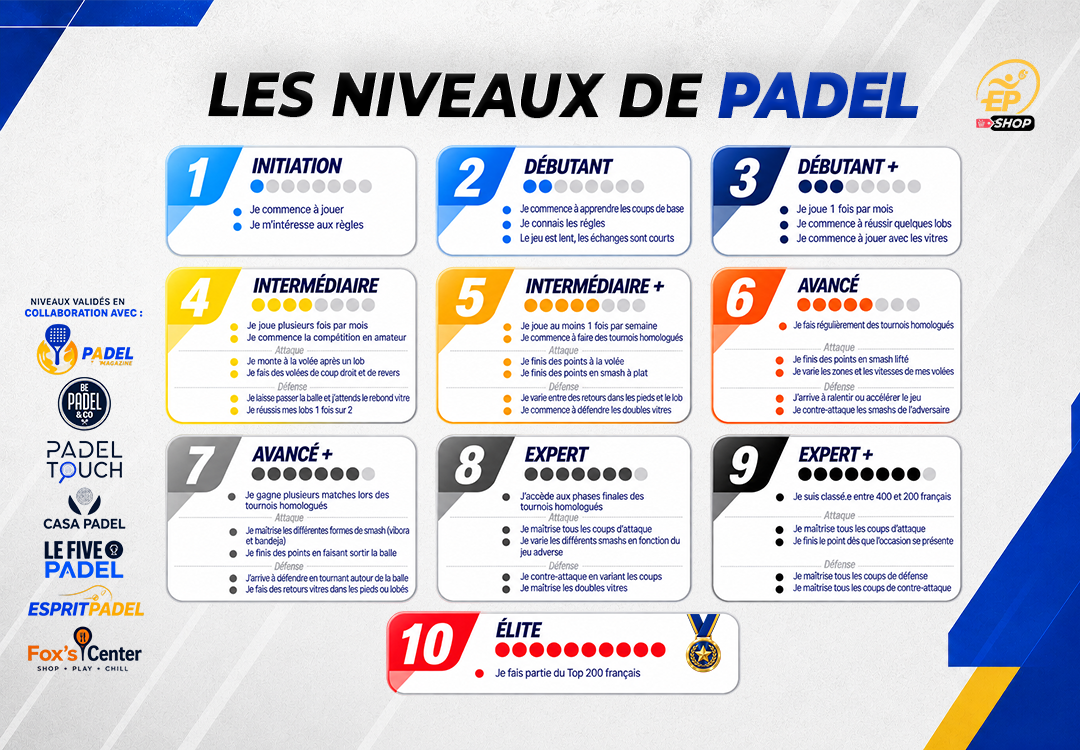
In padel, the level corresponds to a self-assessment scale from 1 to 10, ranging from complete beginner (level 1) to elite player (level 10), most often assigned by coaches. This unofficial scale is used to arrange balanced matches: it should not be confused with the official FFT ranking, which depends solely on tournament results. Knowing your padel level helps you find suitable partners, target the right tournament, and choose a racket that suits you.
|
Key takeaways • The padel level scale runs from 1 to 10: 1 to 3 (beginner), 4 to 5 (intermediate / confirmed), 6 to 7 (advanced), 8 (expert), 9 to 10 (elite). • This scale is unofficial and assigned by coaches: it differs from the FFT ranking, which is based on tournament results. • Levels 4 and 5 represent the majority of regular players in France. • A simplified 8-level scale has been adopted in many clubs since 2025 to help identify player levels. • Each tier corresponds to tournament categories: P25 from level 4-5, P100 and P250 around 6-7, P500 and P1000 for levels 8 to 10. |
Table of contents
• How are padel levels determined?
• Towards a simplified 8-level scale introduced in 2025
• Levels 1 to 2: introduction to padel
• Level 3: beginner
• Levels 4-5: confirmed level
• Levels 6-7: advanced level
• Level 8: expert level
• Levels 9-10: elite level
• How to reach the next level?
• How to assess your level?
• What is the difference between rankings and levels?
• Frequently asked questions
When starting out in padel, this exciting and dynamic sport, understanding the different playing levels is essential to find your footing and have an enjoyable experience against your opponents. Whether you are an enthusiastic beginner or an experienced player looking for new challenges, knowing your padel level is essential to find the right playing partners and make the most of the game.
Discover how to assess yourself on the padel scale and take your game to new heights!
How are padel levels determined?
As everyone knows, padel is a fast-growing sport whose popularity is constantly rising, especially in France. With a new developing sport comes a new rating system to categorize players and enable balanced matches. In padel, two types of rankings exist: the official national ranking, and the unofficial 1 to 10 rating. The latter was created based on a simple observation: the majority of padel players do not compete in sanctioned tournaments, so a dedicated level scale was needed for them.
Some French clubs decided to introduce a simple system so everyone could find their way. Simply rated from 1 to 10, players can place themselves among others and take part in balanced matches. Coaches usually assign levels to players they observe, leaving no room to cheat or overestimate yourself!
The padel levels scale is generally based on a combination of criteria such as playing experience, technical skills, team coordination, competition results, and so on. Lower levels (1 to 3) are assigned to beginners, while higher levels (8 to 10) correspond to high-level players, often professionals or competitive players of a high calibre.
Towards a simplified 8-level scale introduced in 2025
Since 2025, a simplified 8-level scale has been adopted across many French clubs and tournaments. The goal: make player assessment easier by grouping the closest tiers together. You find the same main categories (beginner, intermediate, advanced, confirmed, expert), but with fewer sub-levels and descriptions focused on shot mastery (such as the bandeja and víbora), defending off double glass, and consistency.
However, the 1 to 10 scale remains the most widespread for open games and self-assessment: that is the one we detail below. Whichever scale is used, the principle remains the same: assess yourself honestly to play balanced matches and improve faster.

Levels 1 to 2: introduction to padel
Because everyone has to start somewhere, the first levels are awarded to beginners learning the rules of padel but picking up a racket for the first time in their lives. Ball striking is hesitant and rallies are short. In the middle of learning, players start picking up basic shots: forehands, backhands, and serves. This is the level players stay in for the shortest time, as progress is rapid.

Level 3: beginner
The fundamentals are in place, and basic shots are more or less mastered. Lobs and using the glass walls start to appear in the game, and padel specifics—such as not using topspin like in tennis and hitting more slice shots—start to be integrated. The playing frequency for level 3 players is around once or twice a month.
Levels 4-5: confirmed level
For the confirmed level, the playing frequency increases: between 3 and 5 times a month. Levels 4-5 represent the largest group of players, especially former tennis players taking up padel. Basic shots are increasingly mastered, and shots unique to padel start being used. In attack, confirmed players move up to the volée after a lob and know how to finish points at the volée with a flat smash or a precise shot, both forehand and backhand. On defence, glass rebounds are understood, and occasional double-glass rebounds are returned. At levels 4-5, some tournaments, notably P25s, can be entered with good results (last 16, quarter-finals, or semi-finals).
Levels 6-7: advanced level
Smashes and finishing shots are consistent and effective with topspin to trouble the opponent as much as possible. Some points are also finished by hitting the ball out of the court. But the biggest difference with lower levels is the ability to adapt to the opponent's game. Returns to the feet, lobs, drop shots—all these shots are mastered and start being used to destabilise the opponent based on their play and physical shape. Advanced-level players regularly compete in tournaments such as P100s and P250s.
Level 8: expert level
At level 8, all padel shots are mastered, and every shot is played based on the opponent. In defence, double-glass rebounds are returned consistently, and counter-attacks often hit the mark. Expert players enter many sanctioned tournaments throughout the year, especially P500s where they regularly win two rounds.

Levels 9-10: elite level
Elite players are among the best in French padel. Ranked in the top 1 to 400 in France, elite players are technically flawless. Their matches are decided primarily on tactics depending on the opposition. Regularly placing well in P500 tournaments, and sometimes in P1000, level 9-10 players can start getting sponsored by padel brands and potentially earn prize money from tournaments.
Please note that coaches at each club assign the levels. For example, a level 6 can vary between clubs and cities. We hope you will be able to find your place among these levels and find the opponents to help you progress. Don't forget to take a tour on Esprit Padel Shop to get the best equipment at the best price!

How to reach the next level?
To move up to the next level in padel, here are a few practical tips:
• play regularly to develop your skills and improve your game;
• work on your technique by asking experienced players or a coach for advice;
• improve your physical fitness to perform better on court;
• take part in competitions to test your skills in real match situations;
• analyse your game by watching videos of your matches.
In addition, having the right equipment for your level is essential. Choose a padel racket that matches your playing style and preferences. More advanced rackets can offer more power and control, but finding the one that best suits your level is crucial. Likewise, opt for padel shoes that provide good grip, cushioning, and support so you can move effectively on court and avoid injuries.
To take it further, our detailed tips to improve at padel help you structure your training sessions and work on the right shots at the right time.
By keeping these tips in esprit and staying motivated, you can improve and move up to the next level in padel, fully equipped with the right gear for your playing standard.
How to assess your level?
To determine your padel level, several aspects need to be taken into account:
• Your playing experience: how long have you been playing padel? If you are a novice and have not mastered the basic shots, you will be considered a beginner player.
• Your technical skills: assess your mastery of different basic techniques such as driving, the volée, the lob, the smash, etc. The more technical skills you master, the higher your level will be.
• Your competition results: have you taken part in padel tournaments or leagues? Your performance in these competitions can also help determine your playing level.
Do you maintain the same level of play regardless of your opponents? There is no point in being very strong against lower levels and very weak against higher levels. Are you able to adapt no matter who your partner is, and do you keep the same standard of play?
There is no universal rating system for padel levels, and they can vary by region and even club. That is why most padel clubs or associations have their own level scales to make it easier to match players of similar abilities.
If you are still unsure of your level, try playing with players of different levels and assessing yourself against them.
Finally, the best solution to get an objective assessment is to ask a coach. Thanks to their experience and knowledge of the club players' levels, they can help you evaluate your padel level more accurately.
What is the difference between rankings and levels?
As explained earlier, levels are a rather subjective indicator, depending on your form at the time you were evaluated, the coach observing you, and the overall standard of the venue or region. It is therefore not completely precise, but quite practical for getting an idea of your level and joining open games.
The padel ranking, on the other hand, reflects the results you have achieved in padel tournaments over recent months. It is not absolutely precise either: you can play many tournaments, not place very well each time, but still climb the rankings, as every place in a tournament awards points.
The idea is therefore to combine both to get an idea of your real level. And to judge someone at padel, the simplest and most effective way is still to play against them!
Frequently asked questions
How do you find out your padel level?
The most reliable way is to ask a coach, who evaluates your shots, your consistency, and your match play. You can also self-assess using the 1 to 10 scale, then test your estimate by playing against players of different levels. Ideally, cross-reference this feeling with your ranking from tournaments.
Is a level 5 in padel good?
Yes. Unlike a mark out of 10, level 5 does not mean "average": it already places the player in the upper tier of French players. Levels 4 and 5 include the majority of regular players, often coming from other racket sports, who sustain rallies and have mastered basic shots.
What is the difference between the level and the FFT ranking?
The level (1 to 10) is a subjective assessment given by coaches to create balanced matches. The FFT ranking, on the other hand, is official: it is based entirely on your results in sanctioned tournaments over the last twelve months. A player can therefore be a "level 6" without any ranking if they do not compete.
How long does it take to move up a level in padel?
This depends on your playing frequency and your sporting background. With two to three sessions a week, expect generally several months to clear the initial stages, then one to two years per level from the middle of the scale. Progression naturally slows down as you move up.
What level do you need to play a P100 tournament?
The P100 is one of the most accessible tournaments, just after the P25. You mainly encounter intermediate to advanced players, most often around levels 5 to 7 depending on the club. It is a great gateway to experience competition and earn your first ranking points.
Summary
Padel levels, from 1 to 10, provide a simple reference point to assess yourself, find partners of your standard, and aim for the next tier. Keep in mind that they remain subjective: the court remains the best judge. Once your level is identified, the next step is to get properly equipped.