FIND YOUR RACKET
 COMPARE MODELS

"Paddle" refers to stand up paddleboarding, a water sport derived from surfing, completely unrelated to our racket sport. "Paddle tennis" is an ancestor of padel born in the 19th century on cruise ships, which is played in singles or doubles without incorporating the walls into play. "Padel" (with a single d) is the only official term: born in Mexico in 1969, it is played exclusively in doubles, with glass walls and fences that form an integral part of the game.
Key takeaways
-
Paddle = water sport (stand up paddleboarding), completely unrelated to padel.
-
Paddle tennis = historical ancestor of padel, with walls out of play, unlike padel.
-
Padel = the only official spelling of the racket sport born in Mexico in 1969.
-
Padel is played exclusively in doubles, with glass walls and fences integrated into play.
-
The confusion mainly stems from the popularity of the term "paddle" for the water sport, which has a much longer-established reputation.
Table of contents
-
Understanding the terms
-
Origins and evolution of padel
-
Differences in court and infrastructure
-
The rules of the game
-
Playing styles and strategies to adopt
-
Why choose padel over tennis?
-
Frequently asked questions
Are you about to send a message to your mate to invite them for a game of "padel tennis", but you are unsure about the spelling of the word and the actual name of this sport? That is completely normal, as many versions of this word are circulating.
It is undoubtedly due to its homonym "paddle", which to this day is still better known than the racket sport, that most confusion arises. Indeed, when trying to talk about our sport, people often picture us heading out on the water with a board.
Understanding the terms: padel, padel tennis and paddle
Paddle:
pronounce pa.dəl or

Indeed, this is because the most well-known term is "paddle", which is far from the meaning of our sport, since it is simply the abbreviation for a water sport derived from surfing, Stand Up Paddle. "Paddle" is the English word for "pagaie".
This sport shares with ours the feature of being fairly accessible and more fun than the sport from which it derives. This is particularly why it has enjoyed widespread success, confirmed in 2013 when paddle was named the most popular outdoor sport in the United States.
The confusion also comes from the fact that the term "paddle-tennis" also exists, but still does not refer to our sport.
Paddle tennis:

It is a racket sport created in the 19th century on cruise ships when passengers wanted to entertain themselves by playing tennis, creating a custom court where the principle is similar to that of tennis. At that time, it was played with paddles, hence the term "Paddle-Tennis", which would be replaced by rackets resembling our padel rackets. This sport, which may seem quirky, nevertheless enjoyed great success, particularly in New York where the first official tournament of this sport took place in 1922.
This sport still exists today, and unlike ours, it is played in both singles and doubles.
Pronounce pa.dɛl or

Origins and evolution of padel
Here is the official spelling of our sport, which originated in 1969 in Mexico. It was Don Enrique Corcuera who created it. Not having enough space to build a tennis court in his garden, he had to adapt to his surroundings by building a smaller court and, for practical reasons, allowing play off the walls, just like in squash! The difference between these two sports is that in Padel there is a net, so opponents do not share the same side of the court.
His friend Alfonso de Hohenlohe, a well-known jet-setter in Spain, fell in love with this sport. He decided to install two courts at his home in Spain at his hotel, the Marbella Club Hotel! It was therefore in this country that padel first developed, but its growth did not stop there.
Indeed, his Spanish friend was not the only one won over by this sport, as an Argentine, after a stay in Marbella, brought the game back to his home country. Padel quickly took hold and the country now has around 5 million players, making it the number 1 nation in terms of participants, ahead of Spain.
Coming back to the spelling, although it could be written "Paddle" in the early days in reference to "Paddle-Tennis", it was in Spain that its spelling gradually changed and became the official spelling of the sport: "Padel" (and "Pádel" in Spanish).
Even if the spelling "Paddle-Tennis" was tolerated and some clubs and even the French Tennis Federation have used the term "Paddle", if you want to sound knowledgeable about this sport, do not make that fatal mistake and use only the term "Padel".
Differences in court and infrastructure
Padel, paddle tennis and tennis are distinguished by their specific courts and infrastructure.
Tennis is played on a rectangular court 23.77 metres long by 8.23 metres wide in singles, and 10.97 metres in doubles. The court is divided by a net 0.914 metres high in the centre. Surfaces can vary: grass, clay, hard or synthetic.
Paddle tennis is played on a smaller court, typically 15.24 metres long by 6.10 metres wide. The net is slightly lower than in tennis. Courts are often enclosed by walls or mesh fences, but, unlike in padel, balls hitting these walls are considered out of bounds.
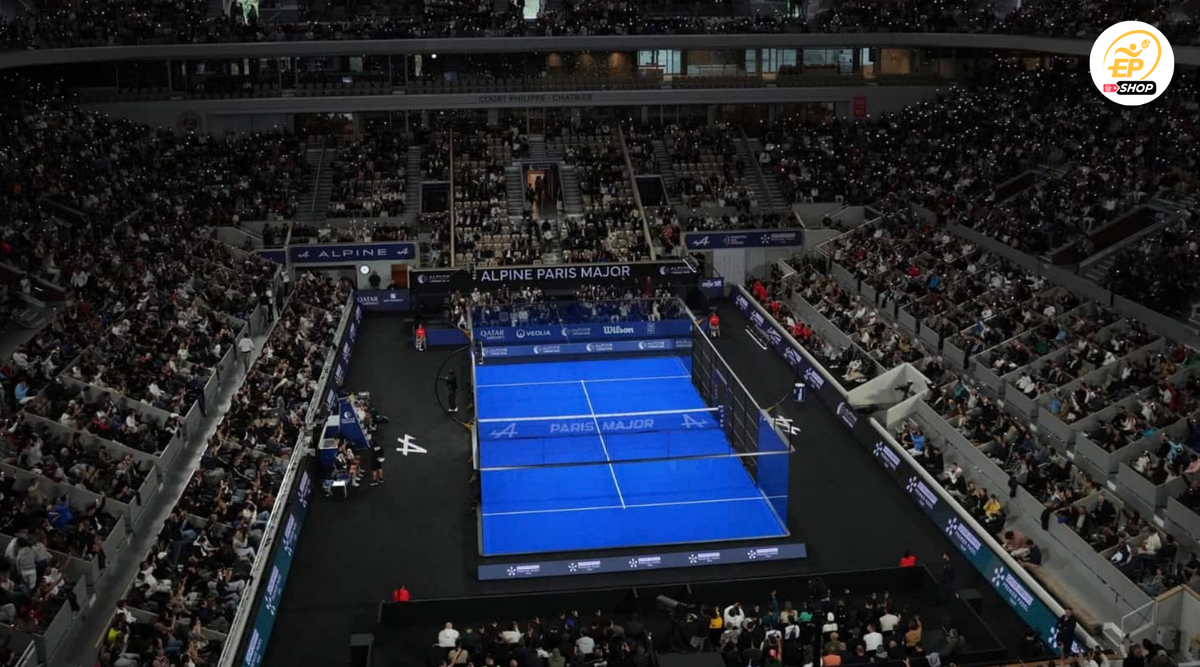
Padel is played on a court 20 metres long by 10 metres wide, surrounded by glass walls and mesh fences. These walls are an integral part of the game, allowing for strategic rebounds. The net, with a height of 0.88 metres at the centre, divides the court into two halves.
Rules of the game: similarities and specificities
Although these sports share similarities, each has specific rules.
Tennis is played in singles or doubles. Players must hit the ball over the net into the opponent's court without it bouncing more than once on their side. Points are scored according to a specific system: 15, 30, 40, game.
Paddle tennis uses rules similar to tennis, adapted for the smaller court size and the lack of strings on the rackets. The serve is hit "underhand", and rallies are faster, favouring net play. The walls surrounding the court are not used during play; a ball that hits them is called out.
Padel is played exclusively in doubles. The serve is hit underhand, diagonally, with a bounce on the ground before impact. The walls surrounding the court are integrated into play, allowing for strategic rebounds. The scoring system is identical to that of tennis.
Playing styles and strategies to adopt
Each sport requires specific strategies.
In tennis, power, precision and endurance are essential. Players alternate between baseline play and approaches to the net, depending on their style and the playing surface.
In paddle tennis, the fast-paced rallies and player proximity encourage aggressive play at the net. Reflexes and coordination are essential.
In padel, communication between partners is crucial. Using the walls offers unique tactical opportunities, demanding anticipation and creativity. Positioning and building the point take precedence over raw power.
Why choose padel over tennis?
Padel offers several advantages:
- Accessibility: The simple rules and doubles format make padel more accessible and friendly for beginners.
- Socialising: Playing doubles encourages interaction and team esprit.
- Less physically demanding: The smaller court and less strenuous rallies allow for a gentler sport, suitable for a wide audience
Convinced you should take up padel rather than tennis or paddle tennis? Discover our selection of padel rackets to get off to a good start, whatever your budget or playing style.
Frequently asked questions
Should you write "padel" or "paddle"?
The official spelling of the racket sport is "padel", with a single d. "Paddle" refers solely to stand up paddleboarding, an unrelated water sport. It is this spelling confusion that explains most misunderstandings surrounding the sport's name.
Are paddle tennis and padel the same sport?
No. Paddle tennis, which originated in the 19th century on cruise ships, is played in singles or doubles without incorporating the walls into play: a ball that hits them is out of bounds. Padel, on the other hand, is played exclusively in doubles and uses the glass walls and fences as strategic elements of the game.
Can you play padel in singles?
Officially no: padel is by definition a doubles sport. A 1-on-1 variation, called 2-player padel or singles padel, exists recreationally on a dedicated court or by playing cross-court on a standard court, but it is not officially sanctioned in competition.
Why are padel and paddle often confused?
Stand up paddleboarding is a water sport with a much longer-standing public profile, notably popularised in the United States. Padel, newer to the scene, still suffers from this close phonetic homophony, hence the importance of spelling the sport correctly to avoid any confusion.