FIND YOUR RACKET
 COMPARE MODELS
Key takeaways
-
The padel vocabulary includes many specific terms inspired by tennis and enriched by Spanish jargon.
-
Mastering this glossary helps you better understand the rallies, match commentary, and technical tips.
-
Certain key shots like the bandeja, the víbora, or the chiquita only exist in padel.
-
The court, points, and rules follow a logic close to tennis, but adapted for play with glass walls and metal mesh.
-
Knowing padel vocabulary also means better communication with your partner and faster progress on court.
Introduction: a language in its own right
Padel isn’t just a spectacular racket sport: it’s also a world rich in technical terms and unique expressions. Now that you understand the basics of padel, it’s time to tackle the vocabulary!
Between terms inherited from tennis, Spanish influences, and inventions unique to the game, padel vocabulary is well worth exploring.
To help both new players and the most experienced, here is a complete glossary of essential words and expressions you need to know to shine on court.
A
Ace: Perfect serve that the opponent cannot touch. Direct point.
Drop shot : A subtle technique in which the padel ball is hit gently, often so that it passes just over the net and drops quickly, making it difficult for the opponent to reach.
B
Bajada: Shot played after a rebound off the back glass, often hit hard and downwards. It allows you to transition from defence to an attacking finish.
Break point: An opportunity for the receiver to win the game on the opponent’s serve.
Bandeja: Iconic padel shot, hit high with slice to hold position at the net.
Bagel: 6-0 score, nicknamed after the circular shape of a zero.
C
Chiquita: Soft, precise shot aimed at the feet of opponents at the net to regain the upper hand.
Contrapared: Defensive shot hit into the back glass, allowing you to return a difficult ball.
Forehand: Shot hit on the dominant side of the padel racket.
D
Half-volée: Shot played immediately after the ball bounces, often close to the net.
Double fault: Two consecutive missed serves, awarding the point to the opponent.
Double wall bounce: Shot where the ball bounces off two walls, often used to confuse opponents.
E
Deuce: Both teams have the same score (equivalent to deuce in tennis).
Balance: Stable body position before hitting, essential for controlling shots.
F
Service fault: Incorrectly executed serve (ball into the net or out of the box). Two faults = point to the opponent.
Carbon fibre: High-end material used in the manufacturing of many padel rackets, offering power and lightness.
Fibreglass: More flexible, providing greater comfort and control.
G
Grip: Tape wrapped around the handle of the pala to improve hold and absorb perspiration.
L
Let: Serve that touches the net but lands in the correct service box; the point is replayed.
Lob : High, defensive shot sent over the players at the net to regain position at the back of the court.
M
Mini-break: Point won on the opponent's serve during a tiebreak.
EVA foam: Core material inside palas, providing comfort and shock absorption.
N
Nevera (the fridge): Strategy of avoiding playing shots to an opponent, usually the most dangerous one, putting them "in the fridge".
P
Pala: Specific racket used in padel, without strings.
Paletero : The name for a padel bag specially designed to carry padel rackets, padel shoes and other padel equipment.
Por tres (x3): Shot where the ball bounces out of the court over the side wall (3 m).
Por cuatro (x4): Shot where the ball bounces out of the court over the back wall (4 m).
Passing shot : Shot designed to get past an opponent at the net.
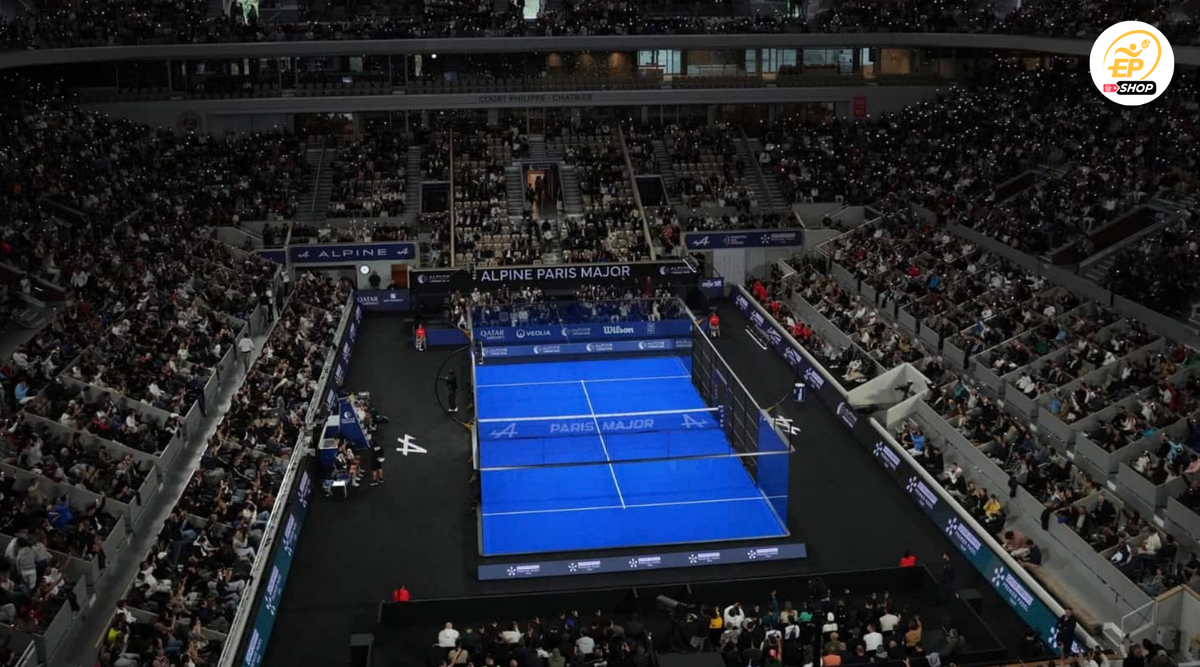
Padel court : The padel court, surrounded by walls and fencing, where the game is played.
Premier Padel: Professional circuit founded in 2022 by QSI, which became the world benchmark following the acquisition of the WPT.
Punto de oro : A special padel rule under which, at deuce, the next point decides who wins the game (the deciding golden point).
Puntaco: Spectacular point, often long and intense.
Punto dulce (sweet spot): Optimum hitting zone on the pala for perfect ball strike.
R
Return: Shot returning the opponent's serve.
Backhand: Shot hit on the side opposite the dominant arm.
Back glass return: Shot hit after the rebound off the back glass, very common in padel.
Rulo: Topspin, rounded shot, often used to bypass the player at the net and drop at their feet.
S
Serve: Shot that starts the rally, diagonally mandatory.
Set: Scoring unit consisting of a minimum of six winning games.
Smash: Powerful, decisive overhead shot to finish the point.
Out-of-court shot: Spectacular play where the player exits the court through the door to return the ball.
Super tiebreak: 10-point decisive tiebreak to separate teams.
Overgrip: Additional wrap used to customise handle comfort.
T
Tiebreak: 7-point game used to decide between two teams at 6-6.
Toss: Coin toss before the match to choose service or side.
Seeded : A pair is said to be seeded when they are among the highest-ranked in the tournament. This protects them during the draw and prevents them from facing other seeds before a certain stage of the competition. For example, the number 1 seed cannot face the number 2 seed before the final.
V
Víbora: Attacking variant of the bandeja, hit with more speed and sidespin.
Volée: Shot hit before the bounce, used at the net to apply pressure.
W
Walkover (W.O.): Victory awarded without playing, when the opponent withdraws.
WPT (World Padel Tour): The former leading professional circuit (2013–2023), which helped popularise padel worldwide.