FIND YOUR RACKET
 COMPARE MODELS

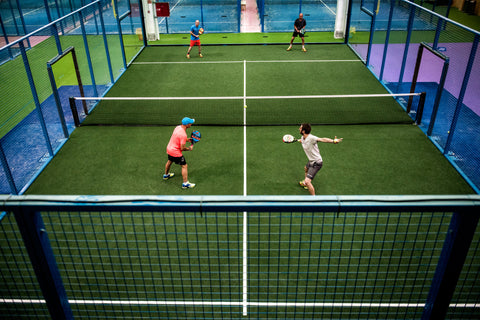
Padel is played two against two on an enclosed 20 x 10 metre court surrounded by glass walls. The scoring system is the same as in tennis (15, 30, 40, game): you need six games to win a set and two sets to win the match. The serve is underarm, below hip height and diagonally across the court. The glass walls are part of the game: after bouncing on the ground, the ball can rebound off them before being returned.
|
Key points to remember • Court: 20 m x 10 m, enclosed by glass walls and mesh fences; net 88 cm high at the centre. • Scoring: 15, 30, 40, game; 6 games to win a set, 2 sets to win a match, seven-point tie-break at 6-6. • Serve: underarm, below hip height, after a bounce, diagonally, with 2 attempts. • Glass walls: can be played off after the first bounce on the ground; you cannot return the ball directly into the mesh fence. • Padel is played only in doubles, and the wrist strap is compulsory for safety. |
Contents
• Dimensions and key features of a padel court
• How scoring works and special cases
• Racket, ball, clothing: equipment that meets the rules
• Specific rules for putting the ball into play with the serve
• How to position yourself for the serve and return
• Rules during play: tennis with glass walls!
• Why doubles is the standard format in padel
• Respect, attitude and team esprit on court
• Frequently asked questions
Is your first padel match coming up, but you don’t know the rules? Don’t worry — this article is here to help. With features such as glass walls and doubles-only play, padel has some fairly detailed rules: you need to get to grips with them to progress with confidence.
Similar to tennis, but borrowing some rules from squash, let’s discover the Spaniards’ favourite sport.
Dimensions and key features of a padel court
First, it’s important to know the court you’re playing on. Smaller than a tennis court, of course, the padel court has just 2 lines marking the service boxes, 6.95 m from the net. There are no tramlines or baseline — the glass walls do that job.
Measuring 20 metres long by 10 metres wide, it is much smaller than a tennis court, even though it is played two against two. The glass walls and mesh fences must also be at regulation heights. The back glass wall must be 3 metres high, with 1 metre of mesh fencing above it. For the side glass walls, the regulation height is 3 metres, with no additional fencing.
Along the sides, glass walls and mesh fences make up the court enclosure: 4 m of glass and 6 m of mesh, including the openings used to enter and leave the court. There must be at least 6 metres of clearance overhead, providing room to play lobs and other high balls. The net must span the width of the court (10 m), with a regulation height of between 88 and 92 centimetres. These numerous regulations can be demanding for clubs adding padel courts, but they are important for players, particularly at a high level, so they do not have to change their habits.

How scoring works and special cases
One similarity between padel and tennis is that points, games and sets are counted in the same way in both sports. Games are scored 15, 30, 40, but whether advantage is played depends on the country or professional circuit. On the World Padel Tour, the “punto de oro” — or golden point — is used: a deciding point at 40-40. Other circuits use the advantage rule.
You need 6 games to win a set and 2 sets to win a match — it’s that simple. If both pairs reach 6 games each, a tie-break is played to 7 points, with a two-point lead required. In some tournaments, a ten-point super tie-break can replace a deciding third set to shorten matches.
Also, as in tennis, players change ends after every odd-numbered game. At the end of a set, if the total number of games is even, players rest and stay at the same ends for one game, then change ends after the next. During tie-breaks (or ten-point super tie-breaks), players change ends and rest every 6 points.
Good to know: depending on the tournament, several official formats are used (with or without a deciding point, or with a super tie-break instead of a third set). If you’re thinking of competing, take a look at our advice on padel tournaments so you know what to expect on the day.
Racket, ball, clothing: equipment that meets the rules
When it comes to equipment, there are very few requirements. You simply need a padel racket and padel balls. Depending on your budget and playing level, there is a wide range of rackets to choose from: light, round, heavy, carbon, with one hole or several… There are many types of racket, so it’s important to choose well!
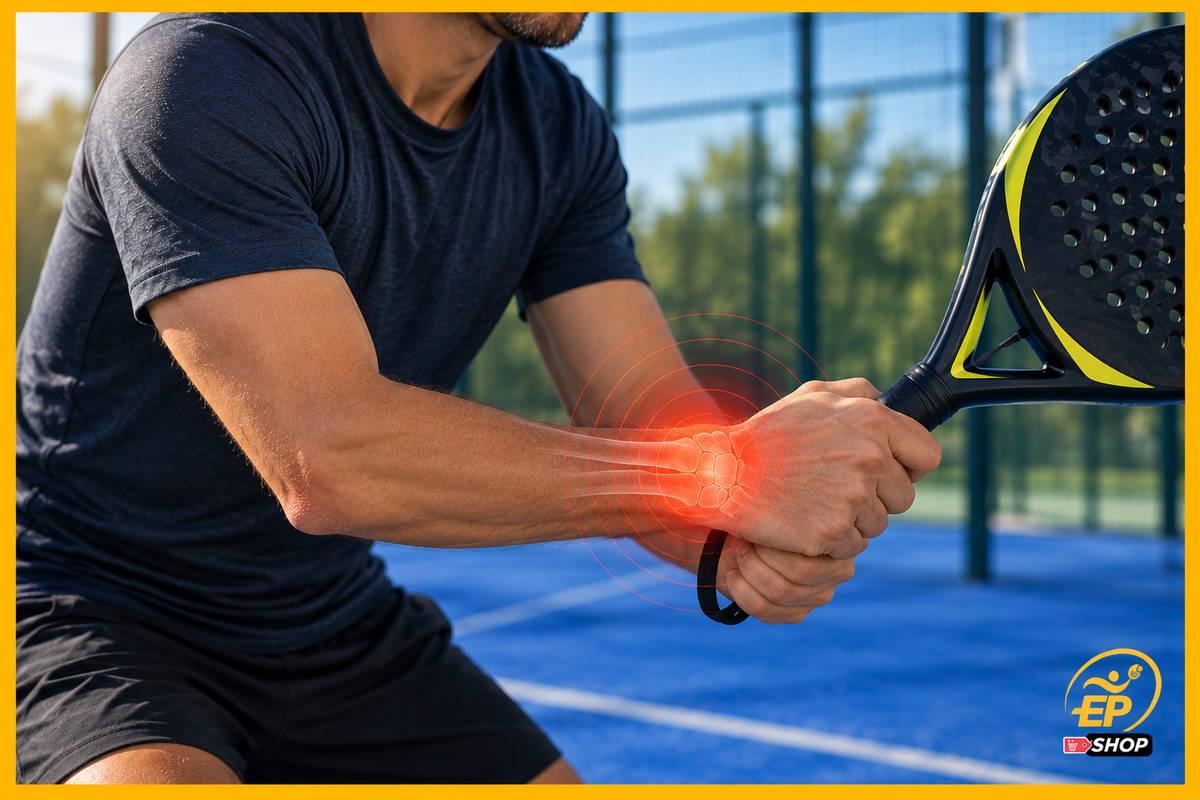
Under the rules, a padel racket is solid, stringless and perforated with holes, and generally weighs between 350 and 390 grams. Above all, one safety rule applies to everyone: wearing the wrist strap is compulsory. This strap loops around your wrist and stops the racket flying out of your hand during a rally and injuring another player. Never forget it, even in a friendly match.
As for the balls you need, padel balls are essentially the same as tennis balls. The only difference is that padel balls are less pressurised and therefore bounce less. For clothing, choose fairly lightweight items that allow fluid movement. At present, the rules impose no clothing restrictions, provided you don’t turn up in a three-piece suit or swimwear, for example.
Specific rules for putting the ball into play with the serve
Serving in padel follows the same pattern as doubles tennis. One player serves for a whole game, then the serve passes to the other team. The aim is for all 4 players to take their tour serving. Within each game, the server alternates sides, starting on the right. As in tennis, you must serve diagonally into the correct service box. Note that the lines on the court are used only for serving. Here are some important points to know about serving correctly:
- In padel, you serve below hip height, underarm, letting the ball bounce before you hit it. Serving from too high is not allowed, to prevent serves from being too fast.
- After its first bounce, a serve must not rebound off the mesh fence. So forget those tricky short, angled serves… However, rebounds off the glass walls are allowed as long as the first bounce is in the service box.
- If the ball touches the net before bouncing in the opponents’ service box, it is a let and the serve is replayed. However, if the serve touches the net and then lands out (outside the service box or against the mesh fence), it is not replayed: it counts as a fault.
- Finally, as in tennis, you get a second serve if you miss the first.

How to position yourself for the serve and return
Padel is played two against two. When a player serves, the 2 receivers can stand wherever they like on the court, but they are not allowed to return the serve with a volée. Most receivers therefore stand behind the line. In padel, positioning between partners is very important: they often move forwards and backwards together to stay in a straight line and give their opponents as few angles as possible.
Because receivers have to return from "the back of the court", servers can take advantage and claim the preferred position: the net. The server must stand behind the line, but their partner can stand wherever they like. They therefore often position themselves at the net, waiting for the server to join them after serving.
During play, players generally take up two positions: at the back of the court or at the net. The intermediate area, around the line, is an area to avoid because it is vulnerable to shots at different angles and depths. The net is the best position to take because it makes it easier to finish points with a smash or a volée. To counter players at the net, a lob is the best option: it forces them back and takes away their advantage. After a lob, players often move up to the net to claim the preferred position and gain the upper hand over their opponents.
Rules during play: tennis with glass walls!
What are the most common faults?
In padel, as in tennis, the most common mistakes are hitting the ball too long or too high. Hitting the net or hitting the glass before the ball bounces are common mistakes among beginners (and some experienced players who won’t admit it). As you spend more time playing and get used to the racket and the size of the court, these mistakes become less frequent — at least when your opponents aren’t putting you under pressure.
Of course, only 1 bounce is allowed before you return a ball hit by your opponents. If it bounces twice, you lose the point. One rule specific to padel is that you cannot return the ball by hitting it into the mesh fence first. Only the glass walls can be used to help return the ball.
Glass walls: an essential part of padel!
The glass walls are THE defining feature of padel, making it a unique sport. You can play a variety of shots off the glass, some of them spectacular, to get yourself out of difficult situations.
In some situations, often when you’re under pressure, you can hit the ball off the glass wall to return it over the net. Whether you use the back glass wall or the side glass walls (which is harder), this often produces spectacular points.
More simply, the “glass-wall return” is a shot worth mastering as soon as possible because it is so useful. After bouncing off the glass, the ball slows down and is easier to return. The challenge with this shot is positioning and anticipating the rebound. You need to be close enough to the glass not to be caught out, and you also need to rotate your hips to send the ball back into your opponents’ court. This movement takes some practice, and beginners — especially former tennis players — often struggle with it at first because it is not very intuitive. But with repetition, the shot becomes more natural and makes certain rallies much easier.

Hit smashes (almost) like the pros.
At a higher level, players can hit par 3 and par 4 smashes. These are powerful smashes that send the ball out of the court. A par 3 sends the ball out at the side, where the glass wall is 3 m high. A par 4 sends it out over the back wall, where the glass is highest. To hit your best par 3 smashes and learn what it takes to pull them off, read this article on par 3 smashes.
Why doubles is the standard format in padel
Another distinctive feature of padel is that it is played two against two. This adds a tactical dimension and a team esprit rarely found in racket sports. Communication is therefore essential in several situations:
- Call out how many opponents are at the net when lobs are played. Your partner can then adjust their shot (lob, drop shot or passing shot) while keeping their eyes on the ball.
- Agree on who takes balls down the middle of the court. After playing more matches together, these details will no longer be a problem.
- To avoid accidents. A padel racket is quite hard, especially the frame, which is sometimes made of carbon. If communication between players is poor, someone can easily be struck by a racket, potentially causing a serious injury.
Positioning on court matters too. The familiar “right-side players” and “left-side players” you often hear about at clubs are defined by where they play. Left-side players are usually the more powerful ones or those with a better smash: lobs played down the middle land on their forehand, making them easier to attack. The padel rackets these players favour are often powerful rackets, allowing them to play even more aggressively.
Right-side players, meanwhile, hit slightly fewer balls and should play with less risk, relying more on lobs and returns than on power. Their diagonal is on their forehand side, normally the most intuitive and easiest shot in padel, so it is easier for them to control the ball. These "playing principles" apply when both players are right-handed. If one player is left-handed, it is best for them to play on the right so they can hit a forehand smash and unsettle opponents who do not know how to defend against it. Communication between players is, however, essential, making padel almost a team sport.
Respect, attitude and team esprit on court
In padel, the most important rules are fair-play and friendliness. On and off court, a friendly atmosphere prevails among players. As in Spain, padel clubs often have a bar or restaurant where players can have a drink or a bite to eat together before or after a match. Above all, padel is about having fun and enjoying yourselves, so don’t hesitate to invite your friends!

Frequently asked questions
How are points scored in padel?
Just like in tennis: 15, 30, 40, then game. At 40-40, you play either advantage or a deciding point (the ‘punto de oro’), depending on the circuit. You need six games, with a two-game lead, to win a set, and two sets to win the match. At 6-6, a seven-point tie-break decides the set.
How do you serve in padel?
The serve is underarm: first you let the ball bounce on the ground, then you hit it below hip height from behind the line. The ball must then land diagonally in the opponents’ service box. You have two attempts, and the ball may rebound off the glass provided its first bounce is in the correct service box.
Can you play off the glass walls in padel?
Yes, and that’s the magic of padel. After the ball bounces on the ground on your side, you can let it hit the glass before returning it. However, you cannot return it by hitting it directly into the mesh fence: only the glass can help you get the ball back into play.
Can padel be played as singles?
In the vast majority of cases, no: padel is played in doubles, two against two. Narrower singles courts do exist, but they are rare. It is doubles play that gives padel its tactical depth, with constant communication between partners.
Is a wrist strap compulsory in padel?
Yes. The wrist strap, which loops around your wrist, is a safety requirement: it stops the racket flying out of your hand during a rally and injuring someone. Padel rackets are solid and stringless, and weigh between 350 and 390 g, so it’s important to keep a firm hold of them throughout the match.
In summary
Padel rules are easy to pick up: an enclosed court, scoring borrowed from tennis, an underarm serve and glass walls that keep rallies going. After a few matches, these principles become second nature. The rest comes with practice on court… and a racket suited to your level.