FIND YOUR RACKET
 COMPARE MODELS

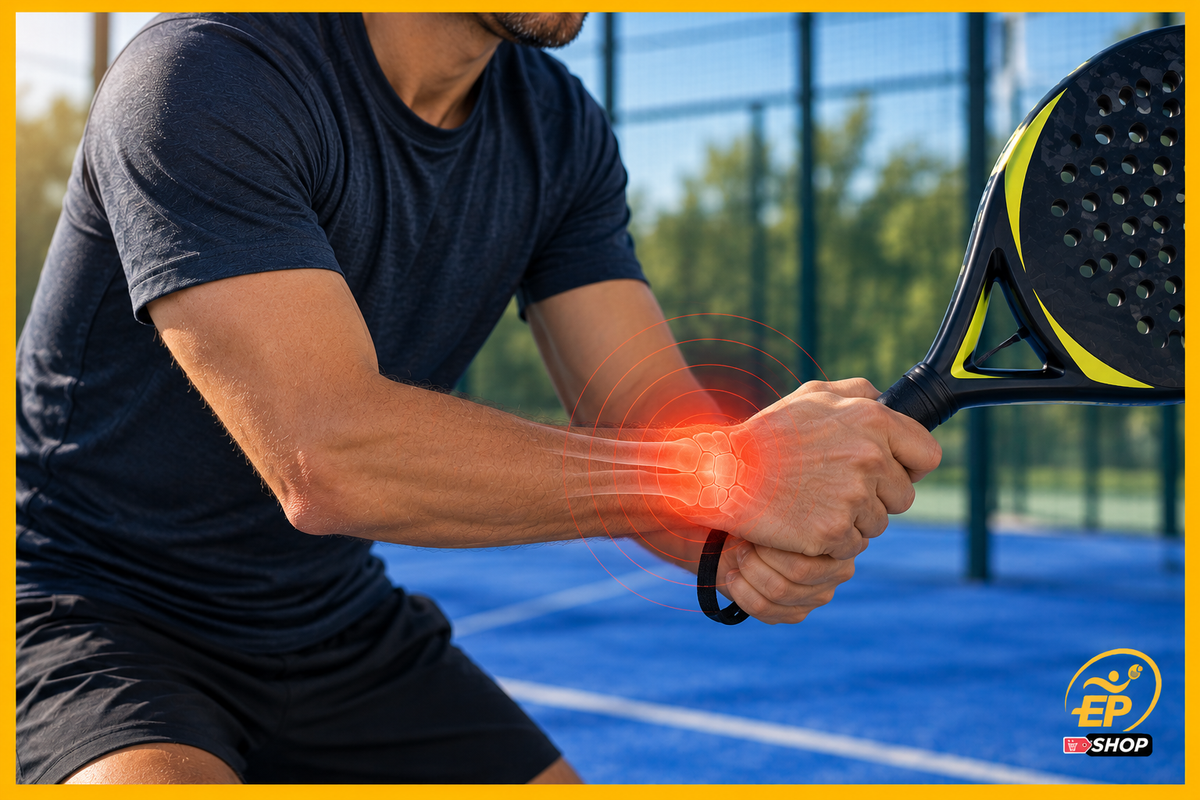
Epicondylitis, or tennis elbow, is inflammation of the forearm extensor tendons attached at the elbow, caused by repetitive movements. Among padel players, it is one of the most common injuries, just as it is among tennis players. Repeated shots, an unsuitable racket grip and poorly absorbed vibrations explain this overrepresentation. Outer elbow pain, difficulty gripping an object or holding the handle: symptoms are often gradual. Here are the padel-specific causes, warning signs to watch for and effective prevention measures.
|
Key takeaways
|
Contents
-
What is epicondylitis (tennis elbow)?
-
Why are padel players particularly exposed?
-
What are the symptoms of epicondylitis in padel?
-
How can you prevent and relieve epicondylitis?
-
Persistent epicondylitis: when should you see a doctor?
-
Frequently asked questions
What is epicondylitis (tennis elbow)?
Epicondylitis refers to damage to the tendons that connect the forearm extensor muscles to the lateral epicondyle, the small bony prominence that can be felt on the outside of the elbow. Contrary to what its name suggests, this injury does not affect tennis players alone: any sport involving repeated gripping movements and wrist extension can cause it, with padel at the top of the list. Repeated strain eventually creates micro-lesions in the tendon, which can develop into chronic inflammation if not treated in time. Today, tendinopathy is more commonly referred to than tendinitis, as the injury mechanism is more degenerative than truly inflammatory. For an overview of all conditions linked to this sport, our article on padel injuries lists the most common ones.
Why are padel players particularly exposed?
Several specific features of padel explain the frequency of this injury on the amateur circuit.
Repetitive movements and racket grip
Forehands, backhands, volleys, bandejas and serves continually place strain on the same tendon groups. A grip that is too tight, often adopted instinctively to gain power, increases the tension placed on the forearm with every shot and accelerates the onset of the micro-lesions that cause epicondylitis.
Unsuitable racket (weight, stiffness, balance)
A racket that is too light encourages players to hit harder to compensate, increasing the vibrations transmitted to the arm. Conversely, a racket that is too stiff absorbs shocks poorly. These racket selection mistakes are common among players who develop epicondylitis after a few months of intensive play.
Vibrations and hitting technique
A late shot, made with the racket face off-centre in relation to the ball, generates far greater vibrations than a centred impact. These vibrations travel directly into the wrist and elbow with every shot, which explains why beginners, who are less consistent in their technique, are often the first affected.
What are the symptoms of epicondylitis in padel?
-
Localised pain on the outside of the elbow, which may radiate to the forearm and sometimes the wrist.
-
Increased tenderness on direct palpation of the epicondyle, often the first sign noticed by players.
-
Discomfort or pain when gripping everyday objects: door handle, cup, car door handle.
-
Pain that typically intensifies during backhands and flat shots, before becoming present even at rest as the injury progresses.
How can you prevent and relieve epicondylitis?
Choose a suitable racket
Choosing a low balance, a reasonable weight and vibration-absorption technologies significantly reduces the load transmitted to the elbow. Certain ranges, such as Pro Kennex padel rackets and their Kinetic system, have been specifically designed to limit this type of injury thanks to internal beads that absorb impacts.
Warm up and stretch properly
A gradual warm-up prepares the tendons for exertion and reduces the risk of micro-lesions from the first rallies. Targeted forearm stretches, performed before and after every session, are among the most effective habits for delaying the onset of epicondylitis in regular players.
Strengthening the forearm muscles
Eccentric strengthening of the wrist extensors, for a few minutes two to three times a week, increases the tendon's tolerance to repeated strain. This simple exercise, which can be done at home with a resistance band or a light dumbbell, effectively complements padel-specific physical preparation.
Using an elbow brace or vibration dampener
A compression elbow brace limits vibrations transmitted to the tendon during exertion, without treating the cause of the problem. Combined with anti-vibration accessories for rackets, it provides a useful complementary solution during a return to play or for players already prone to recurrent pain.
Persistent epicondylitis: when should you see a doctor?
Rest, ice and the adjustments mentioned above are generally enough to relieve early epicondylitis within a few weeks. If pain persists for more than a month despite these precautions, intensifies or disrupts sleep, consultation with a sports doctor or physiotherapist is required. An accurate diagnosis, sometimes confirmed by ultrasound, can rule out another cause and guide you towards suitable rehabilitation, the only way to treat established tendinopathy sustainably.
Frequently asked questions
Does epicondylitis in padel heal on its own?
Mild epicondylitis can ease with rest and a few simple adjustments: a more suitable racket, corrected technique and systematic warm-ups. However, a condition established for several months will most often require physiotherapy to heal sustainably, as simply stopping padel is not always enough to resolve the underlying tendinopathy.
Can you continue playing padel with epicondylitis?
Continuing to play while ignoring the pain may worsen the tendon injury and prolong recovery by several months. It is better to temporarily reduce how often you play, adapt your equipment and treat the pain as soon as it appears rather than wait until it becomes disabling on and off the court.
What is the difference between epicondylitis and epitrochleitis?
Epicondylitis affects the outside of the elbow and the wrist extensor muscles, whereas epitrochleitis, or golfer's elbow, affects the inner side and the flexor muscles. Both injuries share similar causes linked to repeated gripping movements, but epicondylitis remains significantly more common among padel players.
Does racket weight really affect the risk of epicondylitis?
Yes, but not in the most intuitive sense: a racket that is too light often encourages players to hit harder to compensate, increasing the vibrations received by the arm. The right setup therefore depends less on a minimum weight than on a consistent balance between weight, stiffness and the player's level of play.
Summary
Epicondylitis remains one of the most common injuries among padel players, but it can be effectively prevented by acting on several factors at once: suitable equipment, thorough warm-ups and regular forearm strengthening. Adjusting your equipment at the first signs of discomfort is often the simplest way to continue playing padel without a forced break.