FIND YOUR RACKET
 COMPARE MODELS
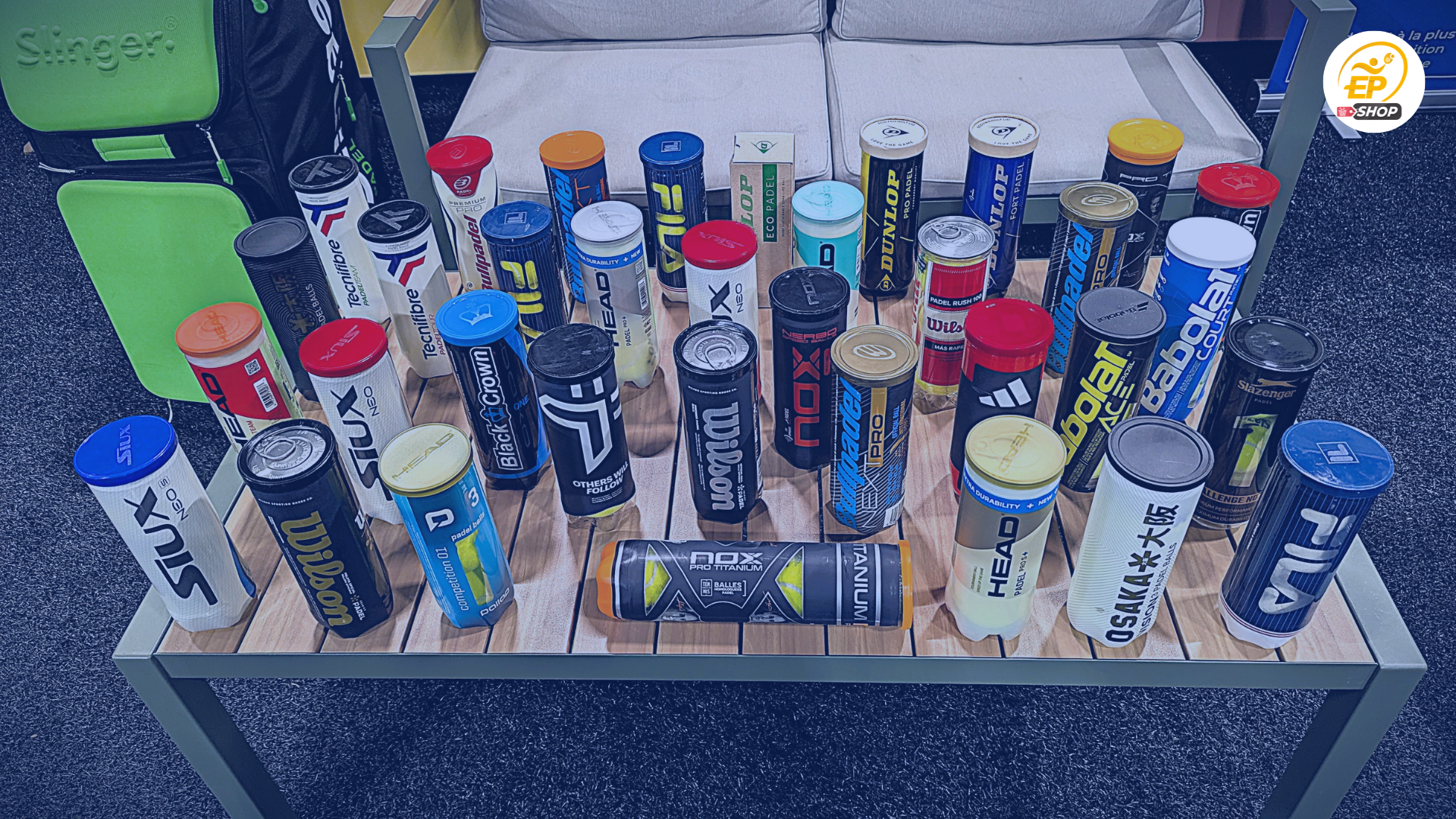
The aim of this final section is to provide you with a systematic analysis framework. In a sport where performance comes down to details, standardised assessment of your balls is a technical and economic necessity. Choosing well means optimising your budget while ensuring consistency in play.
1. The 4 pillars of assessment: the technical appendix
My methodology is based on four essential criteria for analysing a ball, from the moment it leaves the tube to its advanced wear.

1.1. Liveliness (playing speed)
It measures the dynamism of the bounce on the carpet, the glass or the racket.
-
The challenge: A lively ball (e.g. Siux Neo S) favours attack. A moderate ball (e.g. Dunlop Eco Padel) helps with point construction.
-
Technical note: Be aware that high pressure does not always guarantee greater velocity. The quality of the core rubber is equally decisive.
1.2. Feel (impact sensation)
It is the subjective sensation (firmness or softness) felt on impact.
-
Firm feel: Surgical precision and maximum feedback. Ideal for experts.
-
Soft feel: Comfort, vibration absorption and a "trampoline effect". Ideal for protecting the arm.
1.3. Durability (economy and performance)
The ability to retain pressure and bounce after several matches. This is the vital criterion for clubs and regular players (e.g. Oxdog Boost).
1.4. Fluffing (felt wear)
When the fibres of the felt stand up, the consequences are clear:
-
Speed: Loss of 10 to 15% velocity in flight (air resistance).
-
Effects: Contrary to popular belief, excessive fluffing reduces grip on sliced shots.
-
Precision: Micro-turbulence makes the trajectory less predictable.

2. Expert Focus: Debunking myths
Stop confusing liveliness and feel
This is the most common confusion. Liveliness is a dynamic behaviour (energy), whereas feel is a physical sensation (comfort).
-
The "springy" ball: Lively but soft. It bounces strongly but compresses softly against the face.
-
The "stone" ball: Not very lively but firm. It bounces little but delivers a very hard feel. This often comes from rubber that is too dense and lacks elasticity: the ball then feels "heavy".
The "hardness vs power" paradox
Hardness ≠ Power. While for a racket, hard rubber often generates more power, for a ball, rigidity alone is a trap.
The "stone" effect: If a ball is hard but lacks internal pressure, it cannot deform to store energy. It absorbs your force instead of returning it.
The secret of "Turbo" balls: It is the combination of Hardness + Pressure. Compressed air acts like a perfect spring. A ball such as the Bullpadel Next Pro combines a firm structure and high pressure to create the ultimate trampoline effect.

3. The testing protocol: Rigour and objectivity
To ensure the reliability of this test across 32 references, I applied a strict cycle at Cap7 Padel Indoor:
-
Initial assessment (90 min): Test on new balls ("fresh out of the tube" benchmark).
-
Wear cycle (6 cumulative hours): Balls are used by regular players over 4 sessions of 90 minutes.
-
Final validation (1 set): I collect the balls to analyse their remaining qualities (remaining liveliness, felt condition) and validate their actual durability.
4. Buying guide: Your decision-making trio
To simplify your next purchase from Esprit Padel Shop, ask yourself these three questions:
-
A. What is your PLAYING STYLE? (Control ↔ Power)
-
B. What FEEL are you looking for? (Soft ↔ Firm)
-
C. What is your DURABILITY requirement? (Match ↔ Training)

Conclusion: Towards a strategic choice
Choosing a ball is not a detail; it is a decision that affects your enjoyment and your health (joints). Understanding that a lively ball can be soft, or that a durable ball does not necessarily sacrifice performance, gives you real decision-making power.
Padel is a sport of nuance. By refining your preferences according to these criteria, you will develop personal expertise that surpasses any generic recommendation.