FIND YOUR RACKET
 COMPARE MODELS
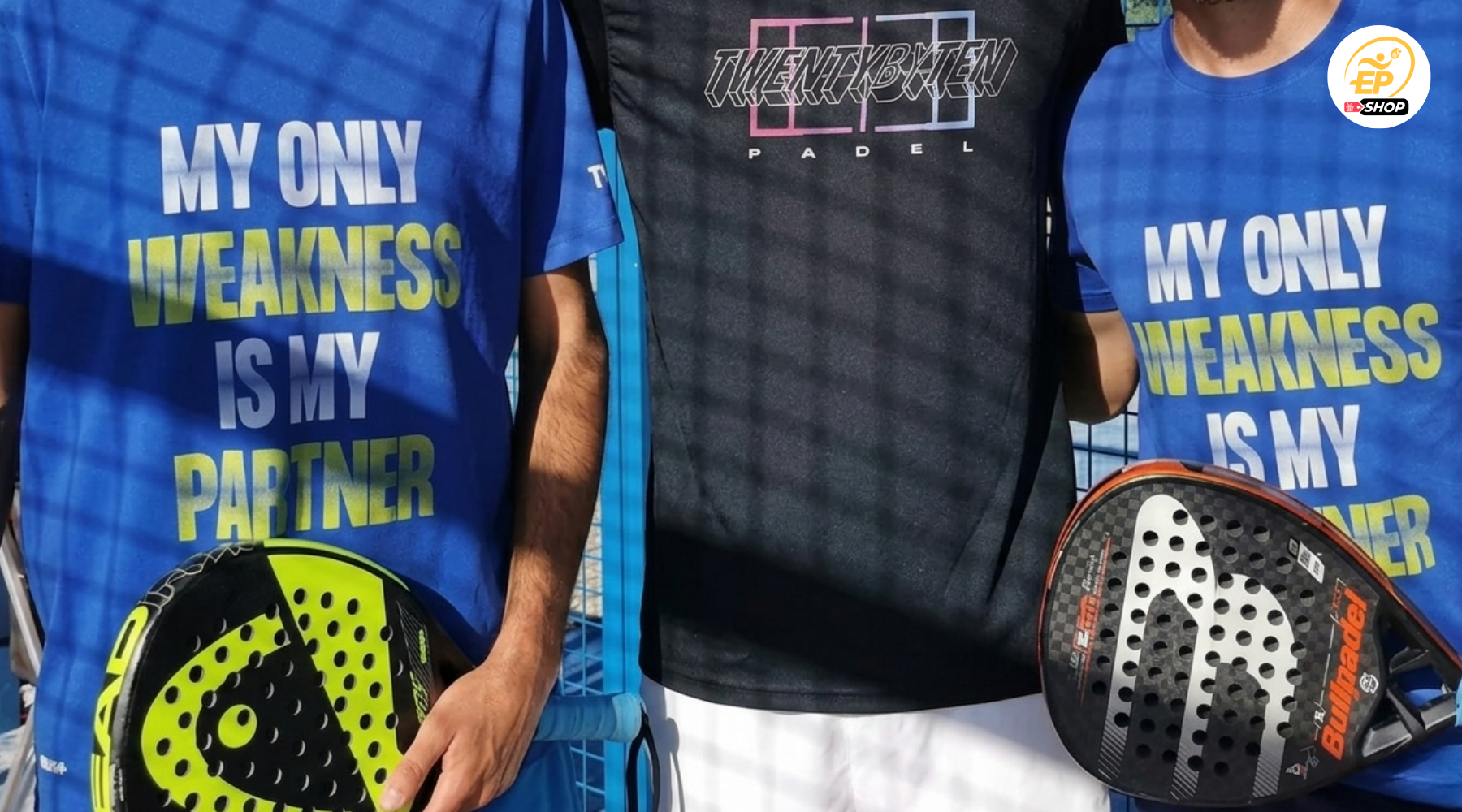
To mark the release of their latest T-shirt “ My Only Weakness is My Partner ”, which translates into French as "ma seule faiblesse c'est mon partenaire", the team at Twenty by Ten looks back at a recurring scenario on a padel court that isn't always justified: blaming your partner ! Yes indeed, this should sound familiar to any self-respecting padel player ;) Michael Kuzaj, co-founder of Twenty by Ten, explains the thinking behind this new tongue-in-cheek design that nonetheless reflects a certain reality on court: we too often forget that padel is a team sport !
LACK OF CLARITY ON COURT: ATTEMPTING TO EXPLAIN
Why is it so difficult to remain clear-headed about what is really happening on court? Several factors come into play, and we'll attempt to break them down.
1. Lack of humility and negativity bias
Padel is still a very young sport, everyone is a “beginner” as they have only been playing for a few years at most. Yet, we've all played with a partner who never stops coaching us, thinking they've unlocked all the secrets of this sport that Belasteguín hasn't even figured out yet. To him it's obvious, he is better than you, because they have a higher ranking, have been playing longer, or simply because they have a naturally big head. Know how to say “I don't know”, and try to be as constructive as possible when making a negative comment to your partner!

Indeed, human beings tend to remember the negative much more easily than the positive: it's the negativity bias rule. Bad news will often stick with you much more than good news, and you give it more importance. And what happens on court is no exception to the rule. If your partner hits 3 great shots during the game, but ends up missing an easy smash on break point, most players will tend to remember only the missed smash.
.
2. Emotions
As in all sports (and not just sport), emotions make us lose our clarity and cloud our judgment. Stress in particular is a real bane! A stressed person will be less tolerant and less patient than a calm one. So try to identify if you are stressed, and make an effort to be supportive of your partner !

.
3. The fast pace
In a match of padel, the pace is fast, points and games go by quickly and we don't take enough time to analyse what's happening. Most of the time, we only remember how the point ended, and not the build-up that preceded the finish.
Example: my partner failed to defend a double glass rebound and made an error. “ We lost the point because of him again, the guy can't defend… ”. Except maybe he missed that defensive shot because just before that I hit to the wrong area and the opponent was able to hit an easy volée, putting my partner in trouble.
Ideally at every changeover (at least at the end of each set), have a quick 2-minute chat with your partner about what worked and what didn't, then set a plan for the next games. This helps to step back a bit, and it's better to do it together than alone because they might see things differently.
BEWARE OF PRECONCEPTIONS
There is also another parameter that influences our judgment: preconceptions regarding the levels. These preconceptions are fabricated entirely from initial information given to me or looked up myself, and most of the time we are not even aware of them.
Let's take an example. I'm a level 6.5 and tonight I have a game with a 5.85 player; in my head I'm already expecting the guy to be weaker than me, starting with a negative preconception that might at some point impact my judgment of him. Yet, we all know this means absolutely nothing, and he might well be at the same level as me or even better!
Rankings are part of these starting factors that we register and take as fixed, and the problem is that these data points condition us constantly and distort our objectivity: I'm playing with someone lower ranked so he's going to be worse than me, or I'm playing guys ranked higher so I'll have to play the match of my life to win, and if I lose 4 and 4 I'll be quite happy with my performance.
.
Another starting factor that will influence our judgment: themy partner's previous results. Example: my partner played yesterday with a strong player, and yet lost to 2 guys I usually beat. So he's not as good as me. FALSE ! Every match is different, there are a thousand reasons why they might have lost: maybe their playing styles don't match, they played on a different surface, in different weather conditions, had poor tactics that day, or maybe one of them had partied the night before…
GETTING THE RIGHT STARTING DATA

When going into a match, it is therefore important to have the right starting information about my partner, and try to disregard the “interfering data” listed above.
The right starting data is obtained simply… by talking to your partner! It couldn't be simpler, yet the vast majority of players skip this step. Do you know the answers to the following questions:
- What is their strength / weakness?
- What do they enjoy doing most on court?
- Do they need a lot of communication or rather the opposite?
By having the answers to these 3 questions, you already have a good idea of the player next to you and you can not only better understand their choices and reactions, but also adapt your game accordingly.
If the guy next to me isn't comfortable when the pace picks up, I might play a few more lobs. If his weakness is more physical, I can take a few more balls in the middle...
.
So don't forget that padel is a team game, make sure your partner is in the best possible conditions and you'll come out stronger too! That said, don't hesitate to wear this T-shirt when you play with them to remind them that you're keeping an eye out, and that you won't hesitate to tease them at every opportunity ;)
.
.

Michael Kuzaj, Co-founder of Twentybyten